Blog
Cross-phase
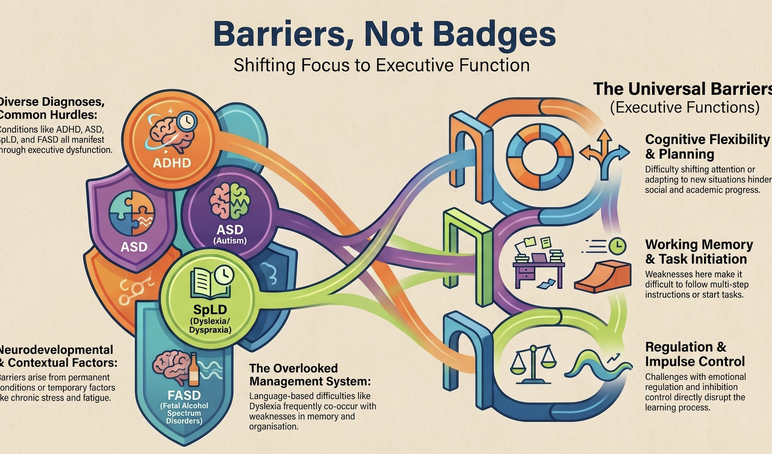
Barriers, Not Badges
The label may tell us something about the child. The barrier tells us what to do next.
Stella Jones
—
Blog
The language we use every day with children may become the voice they eventually use inside their own heads.

Share on:

by Town End Research School
on the
Executive function is one of those things that can sound both incredibly important and incredibly vague. Search for it and you can quickly disappear down a rabbit hole of terminology, diagrams and lists of skills (believe me I know). Perhaps the simplest way to think about it is as our brain’s internal coach: the system that helps us keep a goal in mind, draw on what we have learned from the past, anticipate what might happen next and use all of that information to guide what we do in the present.

That internal coach is working constantly, often without us noticing it. It helps us resist an impulse, remember what we are supposed to be doing, change our minds when our original plan is no longer working and keep ourselves moving towards a goal when something more immediately interesting is competing for our attention. For children, however, that coach is still very much under construction, which means that the things we sometimes interpret as laziness, carelessness, immaturity, poor motivation or simply “not listening” may instead reflect the fact that the cognitive systems needed to manage the behaviour are not yet reliably available to them.
One way to see this in action is to imagine a child getting ready to go to the park. They have been told that it is going to rain later, so they need to take a coat and they have the memory of previous occasions when they have ignored that advice and ended up cold and wet. They can draw on that experience and imagine what it might feel like to arrive at the park soaked, so they know, in principle, that taking the coat is a good idea. But then they see their football by the door, remember that they are already late and feel the immediate pull of simply grabbing the ball and running outside. At that point, knowing what they should do is not quite enough. They have to inhibit the immediate impulse and hold the longer-term goal in mind.

That tiny piece of language is easy to overlook, but it is doing something important. The child is using self-directed speech to interrupt an automatic response and guide their own behaviour. They are, in effect, becoming their own coach.
Then, just as they are leaving, they discover that the route they normally take to the park is blocked by a huge puddle. Their original plan no longer works, so they have to consider another possibility, remember an alternative route and change direction. They have to adapt and be flexible to deal with the change in circumstances. Again, self-talk can help.

And throughout all of this, the child has to remember what they need to take with them: their coat, their water bottle and their football, while also keeping the new route in mind. That is working memory, the ability to hold and manipulate information for a limited period of time. They might rehearse it to themselves as they move:

What looks like an ordinary journey to the park has therefore involved the three core executive functions working together: inhibitory control, which helps us stop or resist an immediate response; cognitive flexibility, which allows us to change our thinking or behaviour when circumstances change; and working memory, which allows us to hold information in mind while we use it. These are not separate skills operating in neat little compartments. They constantly interact as we try to manage ourselves, solve problems and pursue goals.

And this is why I think self-talk deserves far more attention than it sometimes gets.
We often ask children to “think”, “remember”, “concentrate”, “stop”, “try another way” or “check what you’re doing”, as though these are straightforward instructions that children can simply act upon. For many children, particularly when a task becomes difficult or demanding, they are not. The ability to regulate our own behaviour depends partly on being able to communicate with ourselves about what we are doing, what we need to do next and whether what we are currently doing is actually helping us to reach our goal.
Self-talk is that communication. It can be spoken aloud, whispered, silently rehearsed in our heads or accompanied by mental images. It is the way we direct ourselves through a task, and the harder the task becomes, the more important that self-directed speech can become.
Think about an adult trying to complete something complicated. We rarely just sit in silence and somehow execute the whole process perfectly. We might say or think to ourselves:

We might not even consciously notice that we are doing it, because the language has become internalised. Yet we are using words to organise our thinking and regulate our behaviour and children need opportunities to develop that same internal voice.
Inhibitory Control

A child who is about to call out might eventually learn to think, Wait. Put your hand up.
A child whose attention has wandered might learn to notice, I’m thinking about something else. Come back.
A child who has become frustrated might learn to tell themselves, Stop. Try something different.
A child who cannot remember what they are supposed to be doing might learn to rehearse, First this, then that.
The important thing is that we should not simply expect this internal coach to appear fully formed.
We have to model it.
We have to teach it.
And we have to give children plenty of opportunities to practise it.
When we say our thinking aloud, we make something invisible visible. For example:
Rather than simply telling a child, “Pay attention”, we can model what paying attention actually involves: I notice my mind has wandered. That’s not what I need to be thinking about right now. I’m going to bring my attention back.
Rather than saying, “Think before you act”, we can model: I really want to do that now, but that’s not the best thing to do. Stop. Think. Choose.
Over time, the aim is for some of that external language to become the child’s own internal language.
Language → practice → internalisation → independence.
This is particularly important when we consider inhibitory control. Inhibition is not simply about behaving nicely or following rules; it is the ability to pause, suppress or resist the response that comes most immediately to mind so that we can choose a response that is more appropriate to our goal. It is the cognitive equivalent of pressing the brakes before deciding where to steer.
And we can practise it in surprisingly ordinary ways. Games such as Simon Says, freeze games and stop-start activities provide repeated opportunities to practise stopping an automatic response, but the same principle can be embedded into everyday interactions.
Before answering a question, a child can learn to pause: Stop. Think. Answer.
When they are about to abandon something difficult, they can learn: Stop. What could I try before I give up?
When their attention has wandered, they can learn: Notice it. Stop. Bring it back.
The point is not that we should constantly narrate children’s thinking for them. Quite the opposite. The aim is to gradually hand the responsibility over.
Cognitive Flexibility

Cognitive flexibility benefits from the same approach. Children need to experience that changing your mind is not necessarily a failure, that a plan can change without everything falling apart and that when something does not work, there may be another way forward. We can deliberately ask, What else could you do?, What has changed? or Is there another possibility?, but we can also model the language ourselves: My first idea hasn’t worked. That’s OK. What else could I try?
Working Memory

Working memory, too, can be supported through language. Rehearsing information aloud, chunking it into manageable pieces and using simple verbal reminders can help children hold onto what they need while they act.
Coat, bottle, football.
First this, then that.
Remember the two things we need to check.
The strategy is not the words themselves; it is helping children discover how they can use language to manage the demands placed on their own memory. This matters because executive function develops through experience. We do something, experience what happens, remember that experience, anticipate what might happen the next time and then adjust our behaviour. Over time, and through varied experiences that allow us to compare situations and make increasingly sophisticated predictions, that feedback loop becomes more developed.

That has an important implication for the adults around children. When a child repeatedly makes the same mistake, forgets the same thing, struggles to get started, becomes stuck when plans change or acts before thinking, our first response can easily become, “But they know this. Why do they keep doing it?” Perhaps the more useful question is, Which part of the internal coaching system is struggling here and what experience, language or scaffold might help?
The child who knows they should take their coat but still runs out without it does not necessarily need another lecture about the weather. They may need repeated opportunities to connect the experience with the consequence, to anticipate what will happen next time and to develop the self-talk that helps them act on what they already know.
The child who knows they should concentrate but repeatedly finds their attention drifting does not necessarily need to be told to “pay attention” more often. They need to practise noticing that their attention has wandered and bringing it back.
The child who becomes distressed whenever a plan changes does not necessarily need to be told to “be more flexible”. They need opportunities to experience manageable changes, to consider alternatives and to develop the language that helps them navigate the change: The plan has changed. That’s OK. What’s my new plan?
And perhaps that is the most useful shift we can make in our thinking about executive function. Rather than seeing these skills as things children either have or do not have, we can see them as developing capacities that we can deliberately nurture. We can make the invisible visible. We can model what it sounds like to think, pause, remember, reconsider and redirect. We can give children language for the moments when they need to stop themselves, hold something in mind or change direction. We can then gradually move from our voice guiding them to their voice guiding themselves.
Because ultimately, the goal is not for children to need an adult standing beside them saying, “Stop. Think. Remember. Try another way.“
The goal is for them eventually to hear that voice inside their own head – their own internal coach.
And perhaps one of the simplest things we can do tomorrow is to start giving that coach a voice.

These may sound like very small phrases, but they are rehearsals for something much bigger: the development of the ability to regulate our own behaviour, manage our attention, hold our goals in mind and choose what we do next. We are not simply telling children what to do, we are teaching them how to talk themselves through life.
Further reading:
Education Endowment Foundations – Metacognition and Self-Regulated Learning Guidance Report
Blog by Town End Research School – Executive Function: the engine of learning and writing
This website collects a number of cookies from its users for improving your overall experience of the site.Read more