Blog
Cross-phase
Feedback, Metacognition and the Knowing-Doing Gap (part 5 of 5)
Stella Jones
—
Blog
Let’s create the conditions where pupils can use feedback to improve – to find their faults, fix them and flourish.

Share on:

by Town End Research School
on the
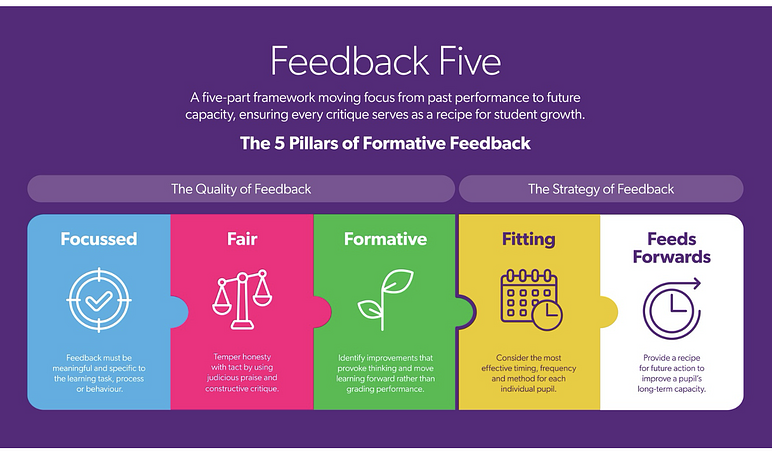
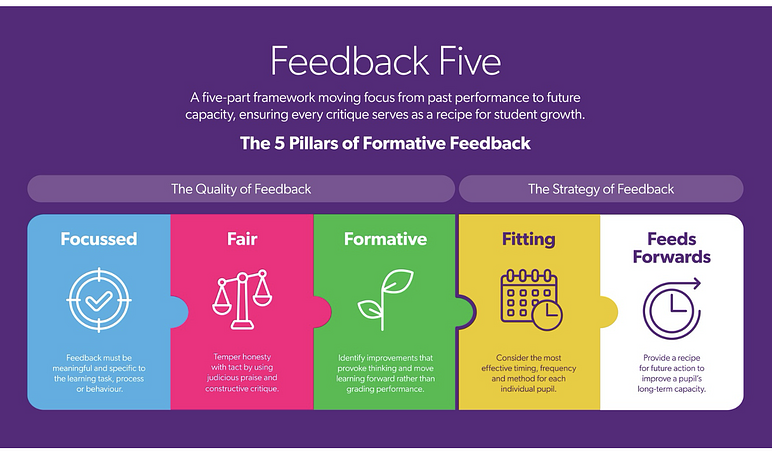
In the last post we introduced Feedback Five and the idea that pupils need to feel safe enough to be wrong before feedback can do its job. That safety is really what the second principle – that feedback should be FAIR – is all about. Here, we dig into what that looks like in practice.
A mistake-friendly classroom
There is a subtle but important difference between saying that mistakes are part of learning and actually creating a classroom in which pupils experience being wrong as a normal and manageable part of learning.
If pupils believe that getting an answer wrong will lead to embarrassment, ridicule, disappointment or a public judgement about their ability, they have a powerful reason to protect themselves. They may avoid volunteering. They may keep an answer in their head rather than risk saying it aloud, or they may copy another pupil, or they may wait for someone else to answer first. In other words, the very pupils whose thinking we most need to uncover may become the least likely to show it. This is why psychological safety matters for feedback.
A mistake-friendly classroom is not one in which anything goes, nor is it a classroom without challenge or high expectations. Quite the opposite. It is a classroom in which pupils are expected to think hard, take intellectual risks, reveal uncertainty and respond positively when their first attempt is not successful.
The EEF’s recent work on adaptive teaching makes this connection particularly clear: teachers need to create conditions in which pupils feel safe to make mistakes so that they are willing to share their thinking. The EEF describes this wonderfully: “Mistakes are information, not identity.“
That is a powerful distinction.
“That answer is wrong” can easily become “I am wrong.” But: “That idea hasn’t worked yet. Let’s look at why.” keeps the focus where it belongs: on the learning. This is where feedback and relationships become inseparable.
The EEF’s Guide to Inclusive Teaching identifies positive relationships and calm classroom environments alongside feedback as universal approaches. The message is important. A pupil’s experience of feedback is shaped not simply by the words the teacher uses but by the relationship in which those words are delivered. Predictable, supportive interactions help pupils feel safe and ready to learn, while calm and predictable environments reduce unnecessary barriers to participation. This means that the teacher has two jobs when giving feedback. The first is to provide information that helps the pupil improve. The second is to create the conditions in which the pupil can hear that information, act upon it and try again.
This is why being fair is so important
One of the five principles of Feedback Five is that effective feedback is fair: honest enough to promote improvement, but delivered in a way that maintains trust and motivation. Fair feedback does not mean avoiding errors because we don’t want pupils to feel uncomfortable. Nor does it mean wrapping every correction in praise. It means treating mistakes as part of the learning process rather than as evidence of a pupil’s worth or ability.

We can be direct without being dismissive.
We can identify errors without humiliating.
We can maintain high expectations without communicating disappointment.
We can say, “This isn’t secure yet. Let’s work out what needs to change,” while simultaneously communicating, “I know you can improve this.”
That combination matters enormously because if we want pupils to become increasingly independent, they need to become comfortable with the uncomfortable business of not knowing, getting things wrong, noticing the problem and trying again. Feedback depends on a classroom culture in which being wrong is safe, because pupils cannot learn to find and fix faults if they are afraid to reveal them.
And perhaps the addition of psychological safety helps us see something that can otherwise be missed.
Effective feedback is not simply about the quality of the information we provide, it is also about the quality of the environment in which that information is received. A pupil who trusts their teacher is more likely to reveal uncertainty. A pupil who knows mistakes will be treated as information is more likely to take a risk.
A pupil who experiences calm, predictable responses is more likely to stay engaged when something goes wrong. And a pupil who repeatedly experiences feedback as something that helps rather than humiliates is more likely to develop the confidence and habits needed to monitor their own learning.
This is inclusion in action.
The EEF’s universal approaches remind us that feedback does not sit in a separate SEND box. It sits alongside explicit instruction, scaffolding, positive relationships and calm classroom environments as part of the everyday teaching that benefits everyone, while being particularly important for pupils who face additional barriers to learning.
Ultimately, the goal is not to create pupils who never make mistakes, it is to create pupils who are willing to make mistakes, able to recognise them, equipped to fix them and confident enough to try again.
Because the long-term purpose of feedback is not to create pupils who wait for a teacher to tell them what is wrong. It is to develop pupils who can increasingly find the faults for themselves, fix them for themselves and carry what they have learned into the next challenge.
Feedback Five is therefore not simply about better feedback, it is about creating the conditions in which pupils can use feedback to become better learners and helping pupils find their faults, fix them and flourish.
The rest in the feedback series:
1. Why Feedback Matters
2. Feedback Five: Helping pupils find faults, fix them and flourish
3. Feedback Five: Why Fair Feedback Matters
4. Feedback Myths and Misconceptions
5. Feedback, Metacognition and the Knowing-Doing Gap
Further reading:
The EEF Guide to Inclusive teaching
EEF – Teacher Feedback to Improve Pupil Learning
This website collects a number of cookies from its users for improving your overall experience of the site.Read more