Blog
Cross-phase
Feedback, Metacognition and the Knowing-Doing Gap (part 5 of 5)
Stella Jones
—
Blog
Context matters. Relationships matter. Timing matters. Most importantly, what pupils actually do with feedback matters.

Share on:

by Town End Research School
on the
If there is one thing the education profession has never lacked, it is opinions about feedback. Over the years, teachers have been told that feedback must be immediate. That it should always be written down. That every piece of work deserves a response. That praise should be wrapped around criticism like the filling in a sandwich. At various points, many of these ideas have become embedded in school policies and accountability systems, often with the best of intentions.
Yet one of the most useful aspects of the Education Endowment Foundation’s Teacher Feedback to Improve Pupil Learning guidance report is that it encourages us to pause and question some of these assumptions. In doing so, it reminds us that feedback is rarely as straightforward as we might like it to be.
Like most aspects of teaching, effective feedback relies on professional judgement rather than rigid rules. What works in one situation may be ineffective in another. Context matters. Relationships matter. Timing matters. Most importantly, what pupils actually do with feedback matters.
Let’s begin with perhaps the most surprising myth of all.
Myth 1: Feedback is always beneficial
At first glance, this hardly seems like a myth. After all, why would feedback ever be harmful? As teachers, we provide feedback because we want pupils to improve. We want them to understand more, remember more and perform more successfully in the future.
Yet research consistently shows that feedback is not automatically beneficial. Its impact depends entirely on its quality and how it is received.
Most teachers can probably think of examples from their own classrooms. A pupil receives a page of corrections and becomes overwhelmed. Another focuses entirely on the grade and ignores the comments. A third disengages because the feedback feels like a catalogue of everything they cannot do.
The issue is not feedback itself. The issue is poorly designed feedback.
Effective feedback reduces uncertainty. It helps pupils understand where they are, where they need to get to and how they might bridge that gap. Poor feedback often has the opposite effect. It can create confusion, reduce motivation and draw attention away from the learning we are trying to improve.
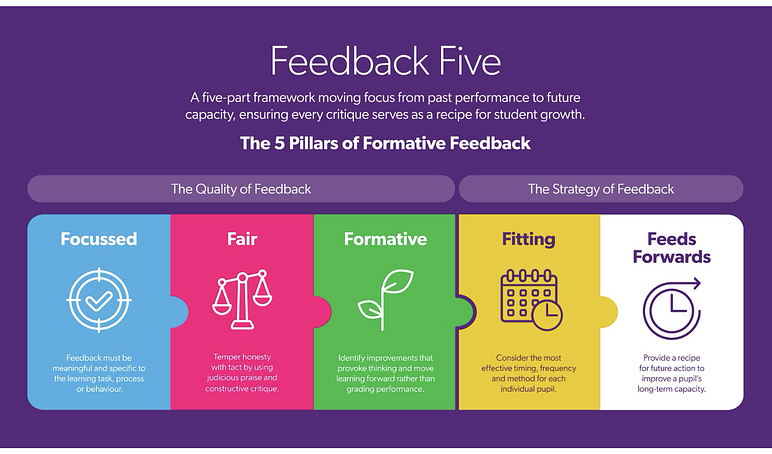
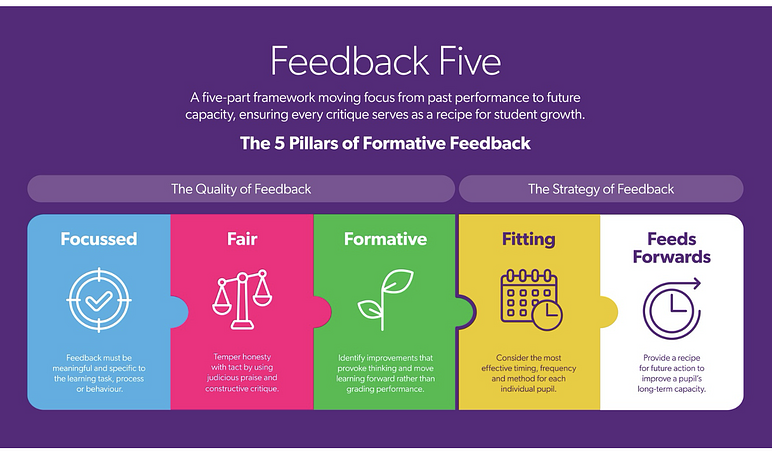
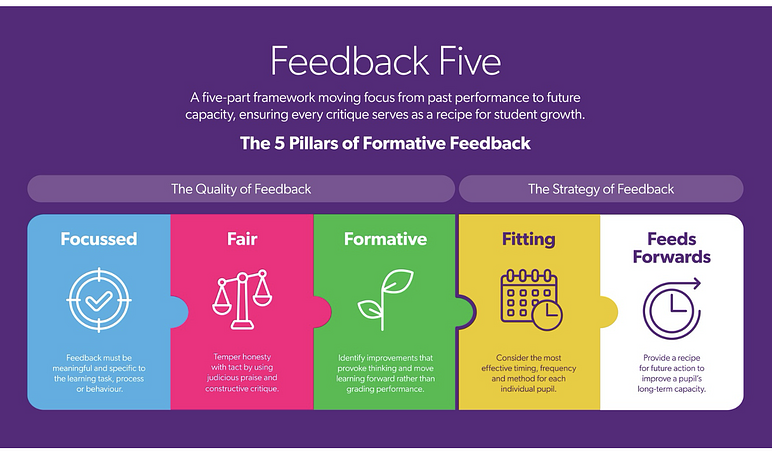
This is one of the reasons the Feedback Five framework emphasises feedback being focused. The more precise and purposeful the feedback, the more likely it is to support learning rather than hinder it.
Myth 2: Feedback should be given immediately
Few ideas have been repeated more frequently than the belief that feedback should be given as quickly as possible. There is certainly some truth in this. If a pupil is learning how to form letters correctly, use scientific equipment safely or follow a specific procedure, immediate correction can prevent errors from becoming embedded. In these situations, delaying feedback may simply allow misconceptions or poor habits to become established.
However, classrooms are rarely that simple. Imagine a pupil wrestling with a challenging problem. Their first approach has not worked. They are becoming frustrated, but they are still thinking. They are testing ideas, rejecting possibilities and searching for a solution. Should we intervene immediately? Well, it depends! One of the most interesting findings from the EEF guidance report is that delayed feedback can often be just as effective, and occasionally more effective, than immediate feedback. By resisting the urge to step in too quickly, we allow pupils to engage in productive struggle. We give them opportunities to think, reflect and grapple with the challenge for themselves.
This is why effective feedback is fitting. Rather than following a universal rule, skilled teachers make decisions based on the pupil, the task and the learning they are trying to develop. So, to help here we offer a rule of thumb…

Myth 3: Written feedback is best
Many teachers will remember a time when written marking occupied a significant proportion of their workload. Pages of comments filled exercise books. Pupils replied in different coloured pens. SLT Book scrutinies often focused as much on evidence of marking as evidence of learning.
The assumption underpinning much of this practice was simple: written feedback must be more effective because it is permanent. Yet the evidence suggests that the format matters far less than the impact.
Think back to the most influential feedback you have ever received as a learner. There is a good chance it came during a conversation. Perhaps it was a teacher asking a probing question, a colleague offering a helpful suggestion or a mentor challenging your thinking at exactly the right moment.
The same is true for pupils. A carefully timed verbal interaction can transform understanding in ways that written comments often cannot. It allows misconceptions to be explored immediately, questions to be answered and dialogue to develop.
This does not mean written feedback has no place. Rather, it reminds us that we should judge feedback by its effectiveness, not its format. A beautifully written comment that has no impact on learning is still ineffective feedback.
Myth 4: More feedback is better
Teaching is a profession filled with generous people. Most teachers genuinely want to help pupils improve and this can sometimes lead us towards providing more feedback than pupils can realistically use. The temptation is understandable. If one comment helps, surely five comments will help more. Yet learning rarely works this way.
Imagine receiving a document covered in annotations, suggestions and corrections. Every point may be valid, but processing them all simultaneously would be difficult. The same is true for pupils. Effective feedback directs attention towards the improvements that matter most. It prioritises, it focuses and it recognises that learning is rarely improved by trying to fix everything at once.
Sometimes the most valuable feedback is not the feedback that identifies every weakness. It is the feedback that identifies the most important, highest leverage next step.
This reflects another important message from the Inclusive Teaching guidance: effective feedback is not about saying more. It is about providing feedback that is sufficiently specific, manageable and actionable for pupils to use.

Myth 5: The feedback sandwich is best
The feedback sandwich (you will know it by another name, that we shan’t use here) has enjoyed remarkable longevity in education. The formula is familiar: begin with praise, insert criticism and finish with another positive comment. The intention is entirely understandable; nobody wants pupils to feel discouraged or demoralised. The problem is that pupils quickly learn how the sandwich works and some skip straight to the criticism because they know it is coming. Others focus on the praise and miss the improvement point entirely. In both cases, the message becomes diluted.
What pupils need is not carefully disguised feedback. They need clarity and that does not mean abandoning kindness or encouragement – far from it! Effective feedback should always be fair. It should preserve dignity, maintain relationships and support motivation. However, honesty and clarity are not incompatible with kindness. The most effective feedback is often both direct and supportive.
Beyond simple rules
Perhaps the biggest lesson from the EEF guidance report is that feedback resists simplification. Teachers naturally look for rules because rules create certainty. Yet the reality of classroom practice is that effective feedback depends on context, timing, relationships and professional expertise. This may be frustrating for those hoping for a quick answer, but it should also be reassuring. The evidence does not point towards a single perfect feedback strategy. Instead, it points towards thoughtful decision-making guided by clear principles.Ultimately, the question is not whether feedback is written or verbal, immediate or delayed, individual or whole class. The question is whether it helps pupils improve. Or, to put it another way, whether it helps them find faults, fix them and flourish.
The rest in the feedback series:
1. Why Feedback Matters
2. Feedback Five: Helping pupils find faults, fix them and flourish
3. Feedback Five: Why Fair Feedback Matters
4. Feedback Myths and Misconceptions
5. Feedback, Metacognition and the Knowing-Doing Gap
Further reading:
The EEF Guide to Inclusive teaching
EEF – Teacher Feedback to Improve Pupil Learning
This website collects a number of cookies from its users for improving your overall experience of the site.Read more