Blog
Cross-phase
Feedback, Metacognition and the Knowing-Doing Gap (part 5 of 5)
Stella Jones
—
Blog
Pupils cannot learn to find and fix faults if they are afraid to show us where the faults are.

Share on:

by Town End Research School
on the
In the previous blog, we explored how inclusive teaching isn’t about different expectations but about responsive teaching and feedback. Feedback is one of the most responsive things a teacher does. It is perhaps no surprise, then, that the EEF’s Inclusive Teaching guidance identifies feedback as one of five universal approaches that should underpin high-quality teaching for all pupils. The other four are explicit instruction, scaffolding, positive relationships and calm classroom environments. Together, these approaches provide the foundation from which inclusive teaching can flourish.
The connection matters because feedback does not happen in isolation. A teacher can have the most carefully designed feedback strategy in the world, but if pupils are reluctant to reveal what they do not know, afraid to make mistakes or worried about how their errors will be received, much of the information needed to make feedback effective will remain hidden.
Pupils cannot learn to find and fix faults if they are afraid to show us where the faults are. This is particularly important when we think about what feedback is actually trying to achieve.
Few aspects of teaching have received as much attention over the past two decades as feedback. Research papers have been published; policies have been written and marking expectations have come and gone. Schools have experimented with everything from detailed written comments and coloured pens to verbal feedback stamps and live marking.
Yet despite all this attention, feedback remains one of the most misunderstood aspects of classroom practice. Part of the problem is that feedback is often discussed as though it were a thing rather than a process. We talk about giving feedback, collecting feedback and evidencing feedback, but far less often do we stop to consider what feedback is actually supposed to achieve.
The Education Endowment Foundation’s Teacher Feedback to Improve Pupil Learning guidance report offers a useful starting point. It reminds us that feedback is not an end in itself. Its purpose is to improve learning. Not to fill pages with comments. Not to make books look pretty. Not to satisfy a policy. Not even simply to improve a particular piece of work. Its purpose is to help pupils improve.
That might sound obvious, yet in classrooms across the country many of us have experienced feedback that appears to work in the moment but has little lasting impact.
Let’s consider a pupil who receives this written comment on their work:
“Use more ambitious vocabulary.”
The pupil responds dutifully. They replace a few words, perhaps borrowing a phrase from the working wall or thesaurus. The piece improves; the feedback has been acknowledged and everyone moves on. A week later, however, the same pupil produces another piece of writing and the very same issue reappears.
What happened?
The feedback improved the work, but it did not improve the writer.
This distinction sits at the heart of effective feedback and, arguably, at the heart of effective teaching itself. We are not simply trying to produce better books, better paragraphs or better answers. We are trying to develop pupils who can produce better work independently in the future. In many ways, feedback is about closing the gap between knowing and doing. Most teachers will recognise this gap immediately. We see it every day. A pupil can explain a grammatical rule perfectly, identify errors in somebody else’s writing and even tell us exactly what they should be doing. Yet when they come to write independently, that knowledge somehow fails to transfer into action.

The same can be true in mathematics. A pupil may confidently explain a method while watching the teacher model it, but struggle to apply it when faced with a problem on their own. In reading, a child may be able to discuss a comprehension strategy during guided practice but fail to use it independently when tackling a new text.
This is where feedback matters. At its best, feedback acts as a bridge between understanding and application. It helps pupils notice errors, refine strategies and develop habits that lead to greater independence. Importantly, it shifts attention away from simply judging performance and towards improving future performance.

The EEF guidance highlights several important features of effective feedback. It should be specific and purposeful. It should focus on improvement. It should encourage pupils to think. Crucially, it should lead to action and this is the point that is often overlooked.
Feedback that sits passively at the bottom of a page achieves very little; it only becomes powerful when pupils do something with it. This is why some of the most effective feedback does not involve the teacher doing more work. In fact, it often involves the teacher doing less.
Imagine telling a pupil, “There are three spelling errors in the first paragraph. Can you find and correct them?” At first glance, this might appear less helpful than simply correcting the errors yourself. After all, it would certainly be quicker. But learning is not measured by how much work the teacher completes. The pupil now has to reread their work carefully, identify possible errors, check spellings and make decisions. They are thinking and reflecting and they are actively engaged in the improvement process.
The feedback has not removed the challenge. It has directed the pupil towards it. But there is something else required before we can expect pupils to engage in this way. They need to feel safe enough to be wrong. We’ll come back to exactly what that safety looks like in the next post — but first, here are the five principles that safety sits alongside.
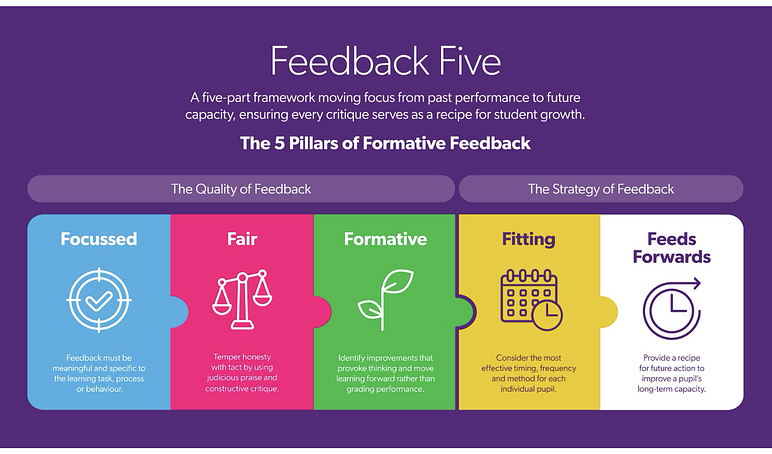
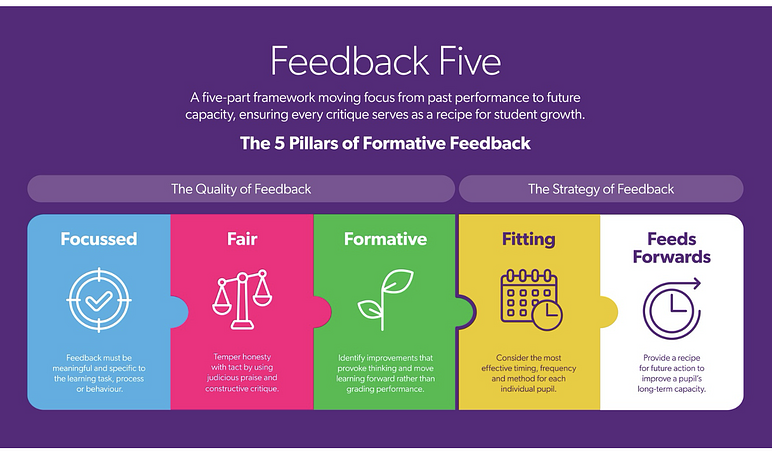
Five principles for feedback
Over time, and through engagement with the evidence base, I found myself returning to five recurring principles that seemed to underpin the most effective feedback practices.

1. Feedback is FOCUSED, it draws attention to the learning that matters most. Pupils cannot act upon everything at once. Effective feedback identifies the most important next step rather than creating a catalogue of everything that could be improved.
2. Feedback is FAIR, it is honest enough to promote improvement, but delivered in a way that maintains dignity, trust and motivation. Fair feedback separates the learner from the learning. We are correcting the work, not judging the child.
3. Feedback is FORMATIVE, rather than simply evaluating performance, it helps pupils understand what they need to do next. This means feedback should prompt thinking rather than simply provide answers. The goal is not to remove the difficulty but to help pupils navigate it.
4. Feedback is FITTING, the timing, method and frequency are carefully considered rather than driven by habit or policy. Sometimes immediate feedback is essential. At other times, delaying feedback gives pupils the opportunity to grapple with a problem, identify an error or attempt to self-correct. The teacher’s professional judgement matters.
5. Feedback FEEDS FORWARD, it improves the learner’s future performance rather than simply correcting their current work. The most powerful question is therefore not, “How will I correct this?” It is: “What do I want this pupil to be able to do independently next time?“
Together, these principles form what I have come to call Feedback Five. The framework is not intended as a checklist or a new initiative. Nor is it a replacement for professional judgement. Rather, it is an attempt to distil some of the most important messages from the research into principles that teachers and leaders can use to guide decision-making.
One principle in particular deserves closer attention. Being fair to pupils depends on more than word choice alone it depends on the classroom culture we build around mistakes. In the next post, we’ll dig into what fairness actually looks like in practice, starting with what it takes to make a classroom safe enough for pupils to be wrong.
This website collects a number of cookies from its users for improving your overall experience of the site.Read more