Blog
Cross-phase
Feedback Myths and Misconceptions (part 4 of 5)
Context matters. Relationships matter. Timing matters. Most importantly, what pupils actually do with feedback matters.
Stella Jones
—
Blog
Teaching pupils how to evaluate their own choices gives them the tools to flourish long after our direct guidance ends.
Share on:

by Town End Research School
on the
One of the most frustrating experiences in teaching is realising that a pupil genuinely understands something and yet still struggles to apply it.
Most teachers will recognise the scenario immediately. A pupil contributes confidently during the lesson. They can explain a concept in their own words, identify examples and even articulate the success criteria. During guided practice, everything appears secure. Then, when the scaffolds are removed and they are asked to work independently, the quality of their performance suddenly drops away.
The pupil who could explain how to use evidence in a written response produces a paragraph filled with unsupported assertions. The child who confidently identified subordinate clauses during the lesson forgets to use them in their own writing. The pupil who successfully completed several examples alongside the teacher becomes stuck when faced with a similar mathematical problem a few days later. When this happens, our instinct is often to conclude that learning has not taken place. In reality, the picture is usually more complicated than that.
Very often, the issue is not that pupils have failed to understand. Rather, they have failed to translate that understanding into independent action. There is a significant difference between recognising a strategy when someone else is using it and selecting that strategy for yourself. There is an equally important difference between understanding a concept in the moment and being able to apply it successfully when faced with a new context, a more demanding task or the absence of teacher support.
This distinction matters because it highlights a challenge that sits at the heart of education. Our goal is not simply to help pupils know more, it is to help them do more with what they know. In many ways, this is the knowing-doing gap.
The knowing-doing gap describes the space between understanding and performance, between recognising and applying, between being able to explain something and being able to use it independently. It is the reason why pupils sometimes leave a lesson appearing secure, only to struggle later when asked to draw upon the same knowledge for themselves.
If we are serious about improving learning, we need to think carefully about how that gap is bridged. This is where feedback becomes particularly important, but perhaps not in the way we often assume.

Traditionally, feedback has been viewed as a mechanism for correcting errors. A pupil makes a mistake, the teacher identifies it and guidance is provided to help improve the work. While there is certainly a place for this, it is only part of the story. The most powerful feedback does far more than point out what is wrong. It helps pupils understand how to monitor their own performance, recognise when something has gone wrong and select an appropriate strategy for putting it right.
In other words, the most powerful feedback is metacognitive feedback. This illustrates why effective feedback supports inclusion. Rather than simply identifying errors, it equips pupils with strategies they can apply independently the next time they encounter a challenge.
To truly close the knowing-doing gap, we must provide actionable frameworks that shift the cognitive load back onto the learner. Download our six practical “Find faults and fix them!” strategies that transform passive recipients into active, self-regulated learners:

By embedding these practical strategies into our daily routines, we ensure that our feedback doesn’t just fix a single piece of work – it fixes the process. Ultimately, teaching pupils how to evaluate their own choices gives them the tools they need to flourish long after our direct guidance ends.
The rest in the feedback series:
1. Why Feedback Matters
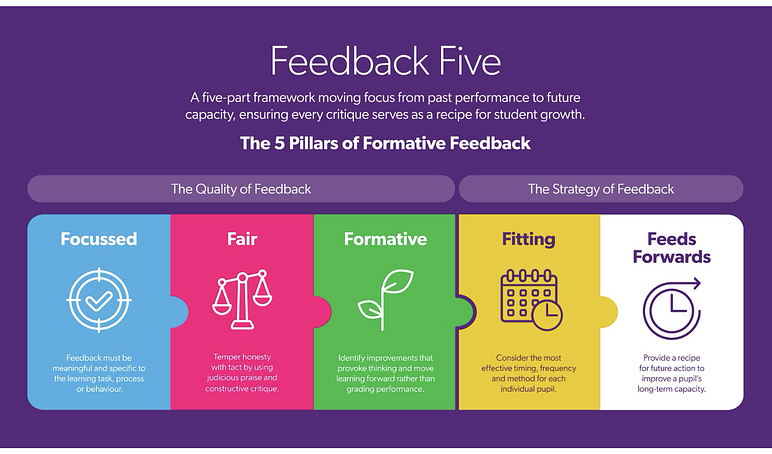
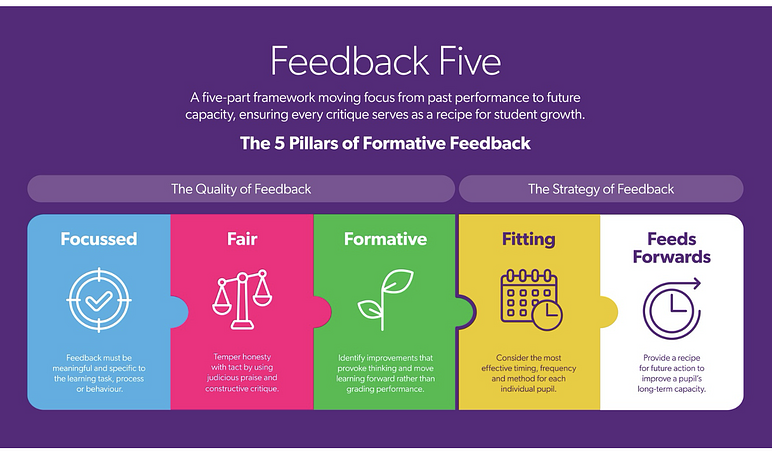
2. Feedback Five: Helping pupils find faults, fix them and flourish
3. Feedback Five: Why Fair Feedback Matters
4. Feedback Myths and Misconceptions
5. Feedback, Metacognition and the Knowing-Doing Gap
Further reading:
The EEF Guide to Inclusive teaching
EEF – Teacher Feedback to Improve Pupil Learning
This website collects a number of cookies from its users for improving your overall experience of the site.Read more