Blog
Cross-phase
Feedback Blog Series: Why Feedback Matters (Part 1 of 5)
Why effective feedback matters for inclusive teaching, pupil progress and developing greater independence in learning.
Jen Ogden
—
Blog
In this blog, Stella Jones explores how executive function supports writing through planning, focus & self-monitoring skills.

Share on:

by Town End Research School
on the

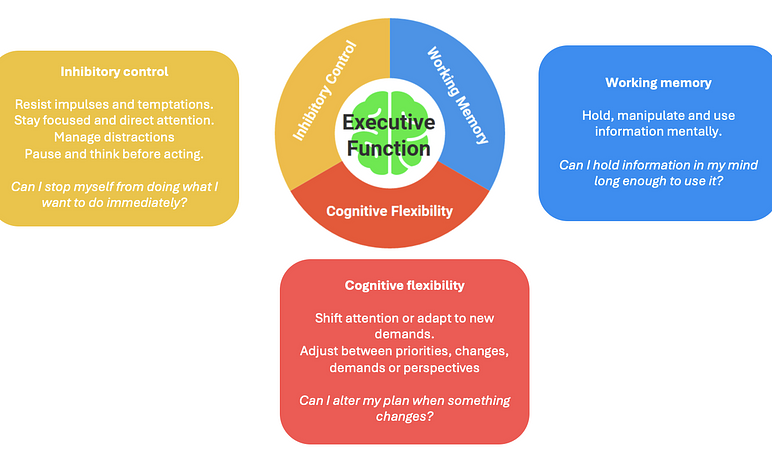
Executive function is the brain’s control centre – the set of mental skills that helps pupils focus attention, manage distractions, hold and use information and adapt their thinking. These abilities are foundational to writing, reading, problem-solving and learning itself. At the heart of executive function is a “mental toolbox” of cognitive processes that includes:
- Working memory - holding and manipulating information in mind
- Cognitive flexibility - shifting attention and adapting to new demands
- Inhibitory control – resisting impulses, staying focused and self-discipline
Together, these skills allow pupils to engage fully with learning, especially in writing, where planning, focus and self-monitoring are essential. Skilled writers need to:
- Plan and organise – generate and sequence ideas before and during writing.
- Focus and sustain attention – manage competing distractions in the classroom and in their own thinking.
- Self-monitor – recognise when their writing goes off track and make necessary adjustments.
Why It matters in writing
Without well-developed executive function:
- Pupils struggle to maintain focus across a writing task.
- They might have ideas but lack a strategy to sequence them.
- They rarely re-read or edit their work for clarity or accuracy.
- Learning doesn’t stick and misconceptions arise.
For example, if a pupil focuses on the wrong part of a modelled sentence, or confuses key phonics sounds because of ambient distractions, they can develop habits that are hard to undo.

“Knowledge isn’t free. You have to pay attention.”
A model for learning
To learn something new – like a phonics pattern or writing structure – pupils must pay attention, hold information in working memory and encode it into long-term memory. But this cognitive journey is fragile. If attention slips or working memory overloads, learning may not happen at all.
Effective teaching supports executive function by helping pupils:
* Set goals and stay on task.
* Apply strategies independently.
* Monitor and adapt their thinking.
What this looks like in the classroom
Take Fred, a Year 1 pupil learning to write with the ch digraph. Despite wanting to do well, Fred struggles to focus during writing time. His sensory memory is overwhelmed by hunger, classroom noise and visual distractions. He fixates on a peer fiddling with magnetic letters, but doesn’t register the teacher’s instructions or the correct modelled sentence.
Fred’s executive function is overloaded – his working memory is juggling too much and his attention is on the wrong things. As a result, he confuses ch with sh, doesn’t plan his sentence and doesn’t notice his error.
This isn’t unusual. When attention, planning or self-monitoring break down, learning stalls and pupils may even encode misconceptions rather than secure new knowledge.
You can read Fred’s story in more detail in the case study accompanying this blog.
“Attention is the currency of the classroom. The gatekeeper of learning.”
What teachers can do:
* Capture attention early – use cues like “This is important!”, gestures and visual prompts.
* Reduce distractions – review the classroom setup, maintain high expectations for behaviour and teach pupils to manage their own attention.
* Support basic needs – check if pupils are tired or hungry. These impact attention and cognitive control.
* Chunk and clarify – break tasks into smaller steps and repeat key phrases to avoid overload.
* Use visual supports – reinforce learning with picture cues, word banks or sentence starters.
* Build routines – predictable structures reduce mental load, allowing more capacity for thinking.
* Practise until secure – don’t move on after one success. Revisit and embed learning.
Key questions to reflect on:
Planning and organising
- How are we explicitly modelling how to generate, structure and sequence ideas before writing begins?
- Are we giving pupils practical strategies – like oral rehearsal or graphic organisers – to help them organise their thoughts?
Focusing and sustaining attention
- How do we help pupils manage distractions and stay focused during writing tasks?
- What routines or supports are in place to strengthen attention and reduce cognitive overload?
Self-monitoring
- Do we give pupils the tools and time to review and improve their writing?
- Are we building in opportunities for self-checking and reflective talk as part of everyday practice?
Coming up next…
In Blog 2, Sarah Stock from Newcastle Research School will unpack transcription – how we help pupils develop the fluency and accuracy to bring their ideas to life on the page.
Further information:
Turning Corners in Writing – Stella Jones explore the value of dictation and how to use it effectively in the classroom.
Routines redeploy attention – Peps Mccrea
Evidence Based Education. (2022) What every teacher needs to know about learning and memory.
A model for the learning process. And why it helps to have one Tom Sherrington
For more on the Simple View of Writing, see the writing recommendations in the following guidance reports:
Improving Literacy in Key Stage 1– Education Endowment Foundation
Improving Literacy in Key Stage 2 – Education Endowment Foundation
Improving Literacy in Secondary Schools – Education Endowment Foundation
This website collects a number of cookies from its users for improving your overall experience of the site.Read more