Blog
Cross-phase
The Voice in Our Head: Why Self-Talk Matters for Executive Function
The language we use every day with children may become the voice they eventually use inside their own heads.
Stella Jones
—
Blog
The label may tell us something about the child. The barrier tells us what to do next.

Share on:

by Town End Research School
on the
Every child can succeed. The question is not whether they can achieve, but what support they need to get them there. Some pupils may simply require a greater dosage of explicit teaching, some may need additional scaffolding or some extra practice. For a few, the solution may be something a short, sharp intervention. High expectations should never be lowered because of a diagnosis.
This is one of the strongest messages running through the Education Endowment Foundation’s new Guide to Inclusive Teaching. The guide reminds us that inclusive teaching is about helping every pupil participate and succeed, recognising that many children face multiple barriers to learning, whether those barriers arise from SEND, socio-economic disadvantage or other factors.
Perhaps most importantly, the guide tackles a misconception that has quietly shaped practice for years:
Myth 4 – “If a pupil has a diagnosis, we automatically know the best way to support them.”
The truth is, we don’t. A diagnosis can provide useful information. It may explain aspects of a learner’s profile, help families make sense of difficulties or unlock additional support. But it does not prescribe teaching. Two pupils with the same diagnosis can present with entirely different strengths, needs and experiences. Equally, pupils with completely different diagnoses may experience remarkably similar barriers to learning and this is why we need to think barriers, not badges.

Rather than asking, “What strategies work for children with ADHD?” or “What should I do for a pupil with ASD?”, a more productive question is: What is preventing this pupil from accessing this learning right now?
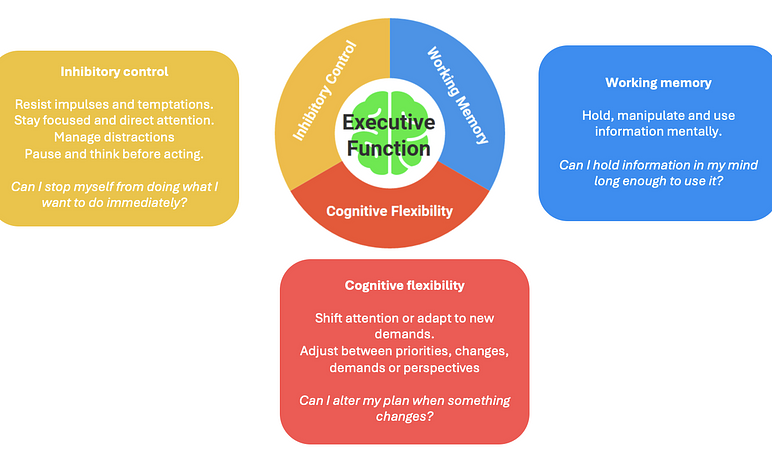
The answer might be to do with immature executive functioning or poor working memory. It might be a language disorder or a barrier linked with emotional regulation. These barriers often cut across diagnostic labels.
A pupil who doesn’t begin their work may appear unmotivated, yet the real barrier may be difficulty organising their thinking, holding instructions in working memory or knowing where to begin. Another pupil who frequently interrupts may not simply be “naughty”; they may struggle with inhibitory control or consequential thinking. This begs the question – could the behaviour problem, or the maturity problem or the lazy problem or the time keeping problem actually be an executive function problem?
See our Big Executive Five resource.

This thinking also helps us avoid what Marc Rowland describes as the “supermarket sweep” approach to inclusion – throwing every strategy associated with a diagnosis at a child in the hope that something works. Instead, effective inclusive practice begins with careful assessment of need, selecting evidence-informed approaches and continually monitoring whether those approaches are actually improving learning. This mirrors the EEF’s emphasis that adaptations should be chosen because they help remove identified barriers and should be reviewed to ensure they support rather than hinder learning.
Meet Salma and consider this question:
If the staff member was focussed on labels might they have adopted a “supermarket sweep” approach and put weak or even harmful interventions for Salma in place?
The label is not the intervention, but the barrier points us towards one.

Dyslexia provides a useful example. Dyslexia describes difficulties with learning to read and spell, particularly in mapping the sounds of language onto written symbols. These difficulties exist on a continuum, from relatively mild to very severe. The term can be useful because it highlights pupils who need additional support with reading. However, many children who struggle to read never receive a diagnosis, and there is no clear line separating those who are ‘dyslexic’ from those who are not.The more useful question is therefore not, ‘Does this child have dyslexia?’ but ‘What EXACTLY is preventing this child from becoming successful?’.If two pupils present with the same reading difficulties, why would we teach them differently simply because one has a diagnosis and the other does not? The teaching should respond to the reading need, not the label.
As researchers – such as Snowling, Hulme & Nation, have argued for many years, our focus should be on supporting all children who struggle to read, regardless of whether they meet diagnostic criteria for dyslexia.
Perhaps the greatest danger of labels is not the label itself, but the reduced expectations that can quietly accompany it. Labels can provide an explanation, but explanations can easily become excuses. If we’re not careful, they stop us asking the most important question: What is it about my teaching, the task or the environment that is preventing this pupil from succeeding?Instead of adapting our practice, we can begin to see the child as the problem to be managed rather than the learner to be taught. When that happens, professional curiosity fades, expectations diminish and underachievement becomes accepted rather than challenged. Low expectations can become a greater barrier than the diagnosis itself.
The EEF’s two-part model captures this beautifully. It begins not with specialist programmes or complex interventions, but with a deceptively simple question:

What do we do every day that is especially important for pupils with additional needs?
That question shifts our thinking away from labels and towards classroom action. It reminds us that the strongest foundation for inclusion is high-quality universal teaching, complemented by carefully chosen adaptations and additional support where these remove genuine barriers to learning. Strong universal provision benefits everyone, while targeted adaptations ensure some pupils can access that provision successfully.
Ultimately, inclusive teaching is not diagnosis-led, it is need-led. It is informed by ongoing assessment, evidence-informed decision-making and careful evaluation of impact, not assumptions attached to a label.

Because – as the sayings go – what is necessary for some is beneficial for all, harmful to none and absolutely crucial for those who need it most. A rising tide really does lift all boats.
Three key messages:
1. High expectations for every pupil.
2. Support should be driven by barriers, not diagnostic labels.
3. The label rarely tells you what to do next – assessment of need does.
Snowling, M. J., Hulme, C., & Nation, K. (2020). Defining and understanding dyslexia: Past, present and future. Oxford Review of Education, 46(4), 501 – 513. https://doi.org/10.1080/030549…
This website collects a number of cookies from its users for improving your overall experience of the site.Read more