Blog
Cross-phase
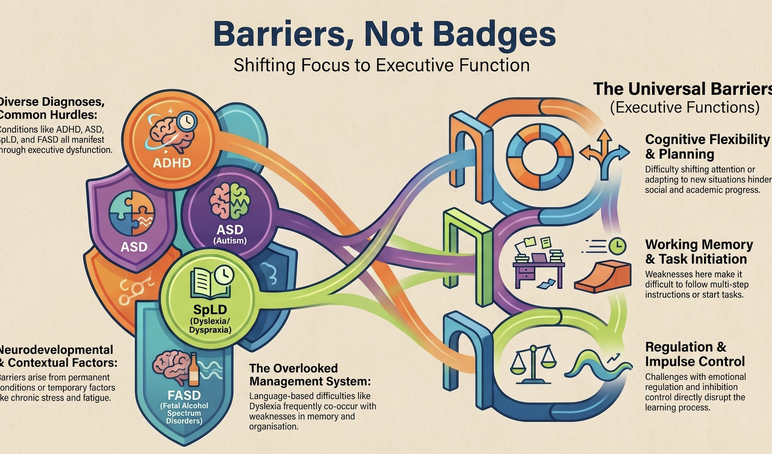
Barriers, Not Badges
The label may tell us something about the child. The barrier tells us what to do next.
Stella Jones
—
Blog
Both spelling and vocabulary hinge on morphemes – the smallest units of meaning in a word.

Share on:

by Town End Research School
on the
Spelling and vocabulary are often treated as separate areas of literacy instruction. One is associated with accuracy and correctness, the other with comprehension and expression. In practice, however, both rely on the same underlying word knowledge. When they are taught together, pupils are better equipped to understand, remember and use language effectively.
Why spelling and vocabulary belong together
Spelling is not simply about letter order, just as vocabulary is not simply about knowing definitions. Both depend on how words are structured, how sounds map onto letters and how meaning is represented and preserved in spelling.
Research into reading and spelling development consistently shows that English spelling is not purely phonetic. It is morphophonemic, meaning that spellings reflect both sound and meaning. This helps explain why related words often share spelling patterns even when pronunciation changes and why spelling cannot be fully explained through phonics alone.
When pupils understand this, spelling becomes more than memorisation. It becomes something they can reason about.
Understanding how words work
Effective spelling and vocabulary instruction rests on an understanding of three interacting systems:
Phonology, which relates to the sounds in spoken language
Orthography, which relates to how those sounds are represented in written form
Morphology, which relates to the meaningful parts within words
Skilled readers and writers coordinate all three systems simultaneously. As words become longer and more complex, morphology plays an increasingly important role. While phonics explains how many words are decoded and spelled, meaning often explains why spellings stay the same across a family of related words.
For example, phonics alone cannot account for the shared spelling in sign, signal and signature or heal, health and healthy. Meaning provides the explanation and stabilises the spelling.

Words as structured systems
When pupils are taught to see words as structured rather than arbitrary, they are better able to generalise what they learn. Instead of memorising individual spellings, they begin to notice recurring patterns.
Consider how meaning and spelling interact in these examples:
happy → unhappy → happiness
view → review → preview → viewer
In each case, understanding the base and the effect of added morphemes supports both spelling accuracy and vocabulary development. Pupils are learning how words behave, not just how they are spelled.
Orthography, meaning and memory
English spelling reflects sound, meaning and history. This layered structure supports word learning when it is made explicit.
Research on orthographic mapping shows that pupils develop fluent reading and accurate spelling when they form strong connections between sounds, spellings and meanings. Morphology strengthens these connections by helping pupils anchor spellings to meaning, making words easier to store and retrieve from long-term memory.
Curriculum alignment
The Primary National Curriculum spelling appendix outlines expected patterns and word forms, but it does not explain why those patterns exist. Without that understanding, spelling can become an exercise in short-term recall.
The July 2025 DfE Writing Framework places greater emphasis on spelling as part of a coherent, knowledge-rich curriculum. This includes teaching spelling within families of related words, connecting spelling to vocabulary and embedding instruction within reading and writing. Morphology provides a conceptual foundation for this approach.
Classroom application
Teaching spelling through morphology does not require additional lessons or programmes. It requires deliberate attention to word structure during everyday teaching.
Approaches such as word sums, identifying morphemes during shared reading and mapping word families help pupils connect spelling, meaning and usage. Over time, this supports more secure spelling and richer vocabulary use.
Key takeaway
Spelling and vocabulary are not separate skills. They are different expressions of the same underlying word knowledge. When pupils understand how words are built and how meaning is carried through spelling, both accuracy and comprehension improve.
Spelling and vocabulary – two sides of the same word – Spelling and vocabulary aren’t separate skills. They’re two sides of the same word. Teach one. Strengthen the other. Do both together and pupils won’t just spell better. They’ll know more.
Small parts, big impact – Want to transform spelling from rote recall to real understanding? Start with morphemes. One base, many words. One affix, a world of meaning.
Spelling it out. What works and why – English spelling has patterns. It also has history. When we ignore that, spelling becomes guesswork. When we explain it, pupils feel empowered
This website collects a number of cookies from its users for improving your overall experience of the site.Read more