Blog
Cross-phase
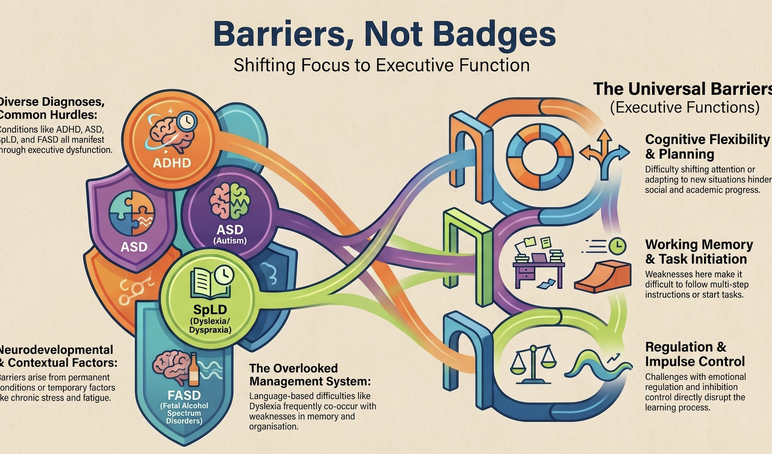
Barriers, Not Badges
The label may tell us something about the child. The barrier tells us what to do next.
Stella Jones
—
Blog
Want to transform spelling from rote recall to real understanding? Start with morphemes.

Share on:

by Town End Research School
on the
Spelling becomes more secure when pupils understand how words are constructed. Teaching morphemes helps pupils recognise patterns that transfer across words, reducing reliance on memorisation and supporting long-term learning.
From memorisation to understanding
Many spelling difficulties arise when pupils are expected to remember spellings without understanding how words are built. This often leads to a familiar pattern: words are learned for a test and then forgotten.
A morphemic approach shifts the emphasis from recall to reasoning. By teaching pupils how base words, prefixes and suffixes work together, we help them make sense of spelling patterns and apply their knowledge to unfamiliar vocabulary.
What is a morpheme?
A morpheme is the smallest unit of meaning in a word. Some morphemes can stand alone, such as play or jump. Others must be attached to a base, such as prefixes (un‑, re-) and suffixes (-ed, ‑ness, ‑ful).
Compound words also reflect morphological structure, combining two base words into a single meaning, such as sunflower or football. Teaching pupils to identify these parts helps them see words as meaningful systems rather than strings of letters.
Why morphology matters for spelling
Research into spelling development shows that morphemes are often visually stable in English spelling, even when pronunciation changes. This stability supports both reading and spelling by providing consistent reference points within words.
For example, the shared spelling across sign, signal and signature reflects meaning rather than sound. Teaching these relationships helps pupils spell with understanding rather than approximation, particularly as vocabulary becomes more academic.
Building progression
Effective morphological instruction follows a clear progression. Early teaching may focus on inflections and compound words, before moving on to common prefixes and suffixes. Later, pupils can explore Latin and Greek roots that underpin much of the language used across the curriculum.
This progression supports cumulative knowledge building and aligns well with curriculum expectations.
Word matrices in practice
Word matrices make morphological structure visible. By organising prefixes, bases and suffixes, they allow pupils to generate and explore multiple related words.
When pupils read, spell and discuss the words they create, they deepen their understanding of how meaning and spelling interact. Word matrices also support transfer, helping pupils recognise familiar patterns in new contexts.

Morphology and orthographic mapping
Morphological instruction complements orthographic mapping by strengthening the links between sound, spelling and meaning. When pupils segment words into phonemes while attending to morphemes, they are more likely to form stable word representations that support fluent reading and accurate spelling.
What the evidence suggests
A substantial body of research shows that explicit teaching of morphology improves spelling, vocabulary and reading comprehension, particularly for older primary pupils and those who struggle with phonics alone. This integrated approach is also reflected in the DfE Writing Framework, which emphasises cumulative knowledge and meaningful application.
Key takeaway
Teaching spelling through morphemes gives pupils tools that transfer. Instead of relying on memorisation, pupils learn how the system works, enabling them to approach unfamiliar words with confidence.
Spelling and vocabulary – two sides of the same word – Spelling and vocabulary aren’t separate skills. They’re two sides of the same word. Teach one. Strengthen the other. Do both together and pupils won’t just spell better. They’ll know more.
Small parts, big impact – Want to transform spelling from rote recall to real understanding? Start with morphemes. One base, many words. One affix, a world of meaning.
Spelling it out. What works and why – English spelling has patterns. It also has history. When we ignore that, spelling becomes guesswork. When we explain it, pupils feel empowered
This website collects a number of cookies from its users for improving your overall experience of the site.Read more