Blog
Cross-phase
Rethinking feedback: Turning classroom patterns into pupil action (part 2 of 2)
How to plan whole-class feedback, address common misconceptions and help pupils act on feedback to improve their work.
Jen Ogden
—
Blog
How whole-class feedback moves beyond marking to identify misconceptions, reduce workload and improve pupil learning.

Share on:

by Town End Research School
on the
Mention feedback in almost any staffroom and it won’t be long before the conversation turns to workload.
For many teachers, feedback has become synonymous with marking. Memories of evenings spent carrying stacks of books home, painstakingly writing comments that took hours to produce and mere seconds to read, are still fresh. The intention behind this effort was always admirable. We wanted pupils to improve. We wanted them to know what they had done well, where they had gone wrong and what they should do next.
Yet over time, an uncomfortable question began to emerge. Was all of this effort actually leading to better learning?
Because there is an important distinction we sometimes overlook: marking is not the same as assessing.

A book can be covered in red pen, annotated with comments and look beautifully marked, but that doesn’t necessarily mean it has been assessed. Marking tells us that we have looked at the work and perhaps made corrections or provided comments. Assessment, however, requires something more. It involves making informed inferences about what pupils know, understand and can do. It means looking beyond the finished piece of work to consider what the pupil has understood, what they may have misunderstood and what they need more practice with.
In other words, the most useful assessment isn’t about how much we have written in a book. It is about what we have learned about the learner.
And that brings us back to a much more important question: what are we doing with that information to improve teaching and learning?
The Education Endowment Foundation’s Teacher Feedback to Improve Pupil Learning guidance report encourages us to think carefully about this question. Importantly, it shifts the conversation away from the quantity of feedback and towards its impact. Rather than asking how much feedback teachers are providing, it asks a far more useful question: what are pupils doing with the feedback they receive?
When viewed through this lens, whole-class feedback begins to make a great deal of sense. At first glance, the idea can feel slightly counterintuitive. Surely feedback tailored to individual pupils must be more effective than feedback directed at the class as a whole? After all, learning is personal and pupils have different strengths, misconceptions and next steps. While this is undoubtedly true, it overlooks something that teachers notice every day when they sit down with a set of books. Patterns.
Rarely do thirty pupils produce thirty entirely different misconceptions. More often, common themes begin to emerge. Several pupils may have misunderstood the same concept. A particular error may appear repeatedly. Equally, there may be examples of excellent thinking, effective vocabulary choices or particularly strong explanations that deserve wider attention. Once we begin looking for these patterns, it becomes difficult to justify writing essentially the same comment over and over again.
Whole-class feedback allows us to step back and respond to what is happening across the class rather than focusing exclusively on individual pieces of work. Instead of treating each error in isolation, we begin to identify trends. What are pupils generally doing well? Where are misconceptions beginning to emerge? What requires reteaching? Which examples might help illuminate success for others?
This shift is subtle but important because it changes the purpose of feedback. Rather than becoming an exercise in correction, it becomes an exercise in responsive teaching.
Looking for patterns rather than isolated errors reflects the spirit of inclusive teaching. Universal approaches begin with high-quality teaching for everyone before additional support is layered where needed. Whole-class feedback enables teachers to respond to common barriers efficiently while still identifying those pupils who may require more targeted support.
In many ways, whole-class feedback is as much feedback for the teacher as it is for the pupils. Imagine, for example, that a large proportion of the class has misunderstood a concept you felt had been taught clearly. It would be easy to conclude that pupils simply were not paying attention. However, whole-class feedback invites a different response. It encourages us to reflect on whether our explanation, modelling or sequence of instruction could be refined. Seen in this way, feedback becomes a two-way process. It tells us something not only about pupil learning but also about our teaching.
Perhaps one of the greatest strengths of whole-class feedback is that it creates opportunities for shared thinking. Too often, feedback remains hidden. A comment is written in a book, read by an individual pupil and then quietly forgotten. The learning remains private. Whole-class feedback brings learning into the open.
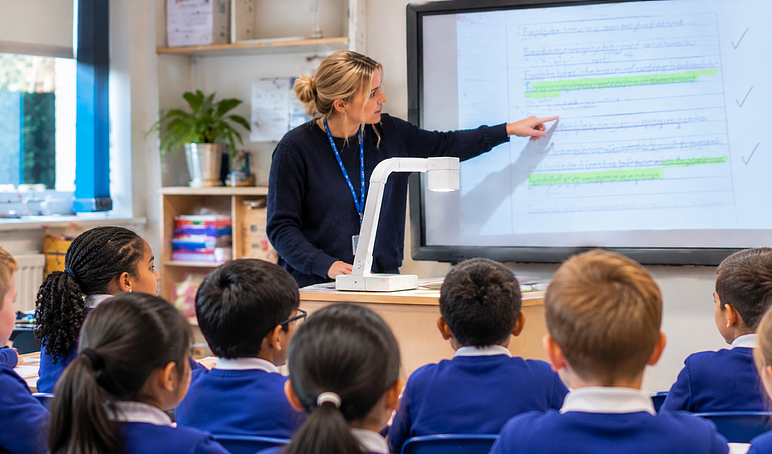
Imagine displaying an anonymous piece of writing under a visualiser. Together, the class explores what makes it effective. They discuss why a particular sentence works well, how vocabulary choices shape meaning or where an explanation could be strengthened. Equally, they might examine a common misconception and discuss how it could be corrected.
In these moments, feedback becomes something pupils actively engage with rather than something that is done to them. They begin to develop a deeper understanding of quality because they can see it, discuss it and evaluate it alongside others. This is particularly important if our goal is to develop independent learners. After all, the long-term aim of feedback is not to create pupils who rely on teachers to identify every mistake. It is to help pupils recognise quality and improve their own work over time.
Perhaps most importantly, whole-class feedback creates something that every teacher wishes they had more of: TIME.
Time to model.
Time to discuss.
Time to revisit misconceptions.
Time for pupils to actually act upon the feedback they receive.
Sadly, this final point is often overlooked but the truth is, feedback only becomes valuable when something changes as a result of it. Yet in many traditional approaches, teachers spend far more time providing feedback than pupils spend using it.
Whole-class feedback helps restore that balance. Less time is spent writing repetitive comments and more time is spent engaging pupils in the thinking, discussion and improvement that feedback is supposed to generate in the first place. That is why whole-class feedback is not simply a workload solution, although it certainly helps reduce unnecessary workload. More importantly, it is a learning solution. It allows teachers to respond to patterns, address misconceptions and create meaningful opportunities for pupils to improve.
And surely that is what effective feedback should be about.
This website collects a number of cookies from its users for improving your overall experience of the site.Read more