Blog
Cross-phase
Rethinking feedback: Why marking isn’t assessing (part 1 of 2)
How whole-class feedback moves beyond marking to identify misconceptions, reduce workload and improve pupil learning.
Jen Ogden
—
Blog
How to plan whole-class feedback, address common misconceptions and help pupils act on feedback to improve their work.

Share on:

by Town End Research School
on the
One of the reasons whole-class feedback has gained so much traction in recent years is that it appears deceptively simple. Unlike some educational initiatives, it does not require complicated systems, extensive paperwork or elaborate tracking processes. At its heart, whole-class feedback is simply about identifying what pupils need and responding accordingly. An example of how this information can be recorded, can be downloaded HERE.
Yet, as with most aspects of teaching, simplicity should not be mistaken for ease. Effective whole-class feedback is far more than standing at the front of the room and sharing a few observations about pupils’ work. Its success depends on careful professional judgement and, perhaps most importantly, a clear understanding of what feedback is trying to achieve.
The process begins long before any feedback is shared with pupils. When reviewing work, it can be tempting to focus immediately on individual pupils. We notice who has struggled, who has excelled and who may require additional support. While these observations are undoubtedly important, whole-class feedback encourages us to widen our lens and look for broader patterns across the class.
• What misconceptions are appearing repeatedly?
• Which strengths deserve celebrating?
• Where are pupils demonstrating secure understanding?
• What might need revisiting through further modelling or explanation?
As these patterns begin to emerge, they often tell a story about learning within the classroom. Sometimes they reveal misconceptions that require immediate attention. At other times, they highlight examples of particularly effective thinking that could benefit the entire class.
This is where a simple crib sheet can be invaluable. Rather than filling books with individual comments, teachers record key observations as they review work. Over time, these observations build a picture of what pupils understand, where they are struggling and what needs to happen next.
Importantly, this process helps ensure that feedback remains focused on learning rather than compliance.
Once these patterns have been identified, the real work begins. One of the biggest misconceptions about feedback is that receiving feedback is the same as acting upon it. In reality, simply hearing feedback does very little to improve learning. What matters is what pupils do afterwards.
This is why effective whole-class feedback sessions are active rather than passive.
Consider the difference between telling pupils that many of them have used weak evidence in their written responses and showing them several examples before asking them to identify which is most effective and why.
In the first scenario, pupils receive information. In the second, they engage in thinking. The distinction is crucial because learning rarely comes from being told. More often, it emerges through the process of noticing, comparing, evaluating and improving. This is why examples can be so powerful. A strong piece of work displayed under a visualiser allows pupils to examine quality in action. They can discuss what makes the work successful, explore the choices made by the writer and consider how those choices might be transferred into their own work.
Similarly, common misconceptions can become valuable learning opportunities when pupils are invited to identify and correct them for themselves. Imagine displaying a paragraph containing several punctuation errors and asking pupils to act as editors. Rather than correcting the mistakes on their behalf, you are encouraging them to apply their knowledge, justify their decisions and engage more deeply with the learning.
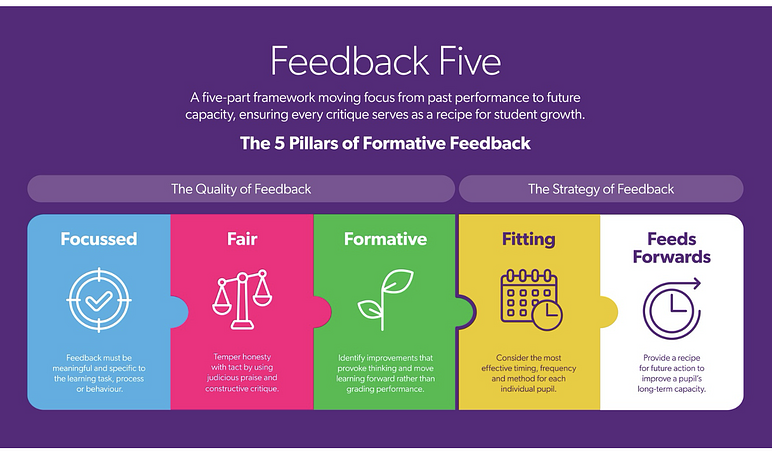
The same principle underpins strategies such as Error Hunters and Spotlight Success. Both approaches encourage pupils to become active participants in the feedback process rather than passive recipients of teacher advice. This matters because the ultimate goal of feedback is not dependency. We do not want pupils waiting for a teacher to identify every error or suggest every improvement. We want them to develop the habits and thought processes that enable them to monitor and improve their own work.
Strategies such as Teacher Think and Recipe for Future Action are particularly valuable in this regard because they shift attention towards future performance. Instead of focusing exclusively on what has gone wrong, they encourage pupils to think about what they will do differently next time.
This is an important distinction.
Feedback should not simply help pupils improve today’s piece of work. It should help them approach tomorrow’s work more successfully. When feedback begins to influence future performance, it moves beyond correction and starts to shape learning. Perhaps this is the most useful question teachers can ask when planning any feedback activity:
What will pupils do with this feedback?
If the answer is unclear, there is a risk that feedback becomes an end in itself. If the answer involves discussion, reflection, revision, comparison, editing or deliberate practice, the chances are that learning is far more likely to follow. Because feedback is not complete when it is given. It is complete when pupils have used it to think differently, work differently and ultimately learn more effectively.
The Inclusive Teaching guidance reminds us that feedback only becomes effective when pupils are given opportunities to respond to it. Planning time for pupils to think, revise and improve is therefore as important as planning the feedback itself.
This website collects a number of cookies from its users for improving your overall experience of the site.Read more