Home

: Five a Day Making inclusive teaching part of every day

Blog


Five a Day

Making inclusive teaching part of every day

Share on:

by Pinnacle Learning Research School
on the

Iqra Hussain

Iqrah Hussain

Deputy Director, Pinnacle Learning Research School (Primary)

Read more aboutIqrah Hussain

When we talk about inclusive teaching, it can sometimes feel like something additional: another resource, intervention or adult supporting a child. Through my work at Broadfield, and more recently supporting another primary school as an Improvement Champion, my thinking has shifted.

What if some of the most effective adaptations are simply part of really good teaching?

This is particularly important when thinking about pupils experiencing socio-economic disadvantage. Disadvantage does not automatically mean SEND, and pupils experiencing disadvantage are not a homogeneous group. However, barriers can accumulate. If pupils have gaps in prior knowledge, vocabulary or learning experiences, what happens in the classroom every day really matters.

For me, the EEF’s Five a day approach has provided a vital framework that identifies five approaches that can be used to support disadvantaged students and those with SEND as part of high-quality teaching. None of the recommendations were ​‘additional’; they were simple strategies that could strengthen teaching for everyone. This reflects the conclusions of my own leadership journey that ​‘evidence is most powerful when we can translate it into something meaningful in our own classrooms’.

Five a day plate

Taking the Five a Day beyond my own school

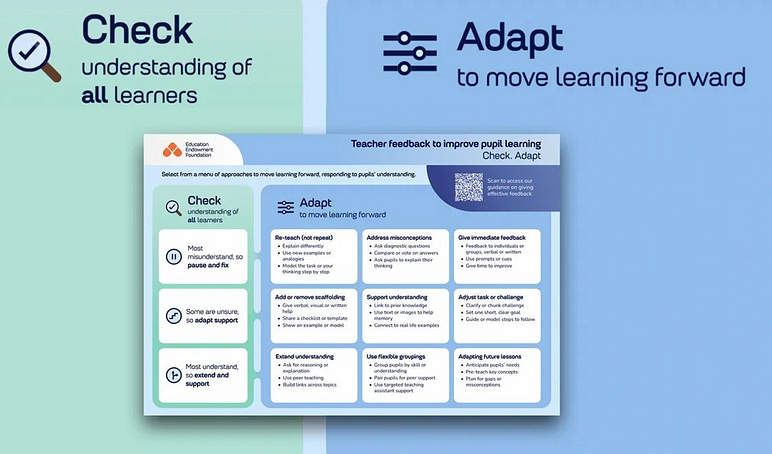
As an Improvement Champion, I’ve had the opportunity to work with a primary school who, following a peer review, wanted to develop classroom adaptation and consider how teachers could use additional adults effectively while still developing pupils’ independence. Using the EEF’s Five a day guidance, alongside the EEF Scaffolding Framework, we began to unpick what inclusive teaching could look like in practice. The question at the centre of my workshop was ​“What strategies can we plan for to ensure that we are adapting learning to meet the needs of all children?” The focus wasn’t about creating multiple worksheets, or placing an adult next to a struggling pupil, and it certainly wasn’t about lowering expectations. Instead, we started thinking about how adapting our teaching, using the EEF guide, could itself remove barriers.

Scaffolding Framework

Making the implicit explicit

In both my roles, a key area for development has been explicit instruction. In my own teaching, I routinely use I do → We do → You do. First, modelling to make my thinking visible, then we practice together and finally, pupils apply their learning independently. It’s a simple approach but the important part is what happens between each stage. Are we checking understanding? Are we modelling the thinking as well as the task? Are we gradually handing responsibility to the pupil? For children who may have gaps in prior learning, including those with socio-economic disadvantage, we cannot assume they will automatically know how to approach a task. Making these processes explicit can provide access without reducing the level of challenge.

Scaffold – but know when to step away


At Broadfield, I have worked with our SENDCo to develop our teacher toolkit containing practical strategies and resources for lesson adaptation, but creating more scaffolds was never our end goal. When adapting work, we wanted staff to think carefully about when a scaffold was needed, why it was needed and when it could be removed. This also applies to adult support. We explored how adults could prompt rather than tell, redirect pupils towards previously taught strategies and then step away. The goal was not simply task completion, it was pupils working towards independence and teachers reflecting ​‘could that child complete it tomorrow without the adult?’ Alongside this we have also developed a whole-school approach to metacognitive strategies and we want children to draw upon strategies when learning becomes difficult. Sometimes the best support we can give isn’t another resource; but teaching them what to do when the support is no longer there, which requires us to model our own thinking:

I am stuck

Sometimes technology can be simple

Creating an inclusive classroom using technology, such as visualisers, has become an important part of everyday teaching. We use them for live modelling, sharing children’s work, editing together and making thinking visible. A pupil’s example can quickly become a model for the whole class, while misconceptions can be explored together. Editing becomes something children can see happening rather than simply being told to improve their work.

From a toolkit to a shared approach


Perhaps the biggest learning for me has been that inclusive teaching cannot ​‘sit in a folder’. Embedding the EEF principles as part of our daily teaching and professional conversations has helped pupils become less reliant on support, while encouraging teachers to think more carefully about when to intervene and, importantly, when to step away. My professional development has reinforced my belief that inclusion is not about making learning easier but is about making ambitious learning more accessible for all students. We need to think carefully about the barriers that some pupils encounter in our classrooms and the Five a day approach gives us a practical language to develop consistency in our school. And one question I now find myself returning to:

Is the support we are giving this child helping them complete today’s task, or helping them become a more independent learner tomorrow?

For me, that is where inclusive teaching really begins.

This website collects a number of cookies from its users for improving your overall experience of the site.Read more