Blog
Primary
Check Adapt
•maths
•Proxies for learning
Check. Adapt. And move learning forwards
How simple changes to our practice can have real impact on our pupils.
Newcastle Research School
—
Blog
Lindsey Fagan, Maths Hub Lead, shares with NRS how we can use an evidence-informed approach to Problem Solving.

Share on:

by Newcastle Research School
on the

Great North Maths Hub
Hub Leader of the Great North Maths Hub.
The first step is to identify the specific barriers pupils face before deciding on the most effective support. Knowing your learners and their needs. EEF Guidance suggests that one reason many pupils struggle with mathematical problem solving is that they lack a systematic approach. Rather than taking time to understand the structure of a problem, pupils often jump straight into calculations. When this happens, they can miss underlying relationships, making it harder to make sense of the problem and identify a pathway to a solution.
Recommendation 3, Teach Pupils to Solve Problems, encourages teachers to focus not just on the what but also the how of problem solving. Pupils strengthen their problem-solving skills when they are supported to:
Unpick the mathematical structure
Represent ideas visually
Think about and review their own approach
By making these habits part of regular practice, problem solving becomes a challenge to explore rather than a hurdle to overcome.
At the Great North Maths Hub, problem solving is a continuous journey of playful exploration. Pupils are encouraged to experiment, notice patterns, and test ideas at every stage, while the mathematical concepts they encounter become increasingly complex.
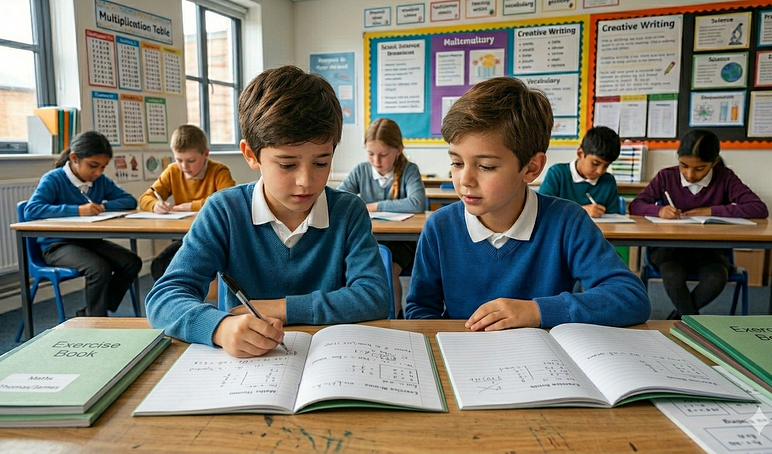
As pupils move into Key Stage 2, visual representations are built upon to help them make sense of the maths within word problems. The bar model is one powerful example: it allows learners to break problems into manageable parts and see the relationships between ideas clearly. In the image below, we can see how pupils used this approach to unpick the structure of the problem:

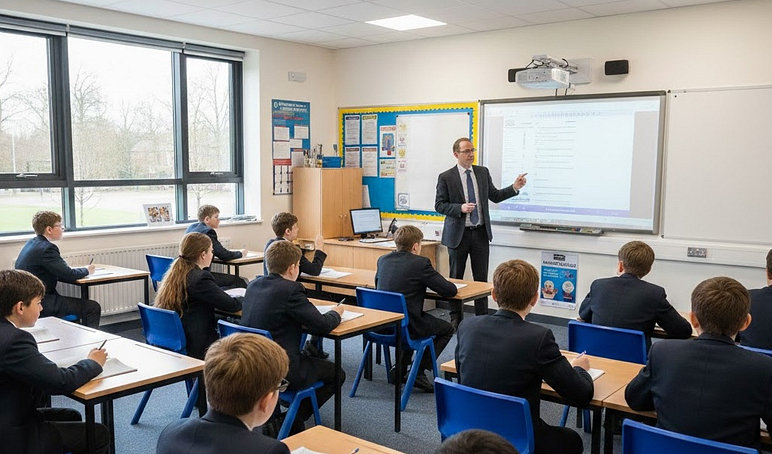
As pupils transition into secondary mathematics, developing independence becomes essential. Encouraging them to monitor their own thinking and ask questions like, ‘Is this working?’ helps build this independence. Physical exploration remains a powerful tool in this process.
In a Year 7 lesson, pupils explored the core concept that the area of a circle is π times the square of its radius through a hands-on question: How many squares fit inside a circle?

By manipulating the shapes and using key stem sentences, learners were able to connect the formula to its meaning; visualising the idea that the area of a circle is a little more than 3 times the square of its radius. One pupil reflected, “I knew this at the start of the lesson, but I didn’t know why,” demonstrating how exploration alongside formalisation deepened understanding.
Across all key stages, the journey of problem-solving moves from playful exploration to structured reasoning and independent thinking. By embedding habits of mind, supporting reflection, and providing opportunities for open exploration, teachers can help pupils approach maths with confidence and curiosity. Problem solving is not a one-off skill; it’s a habit to nurture, a mindset to grow, and a journey that every learner can experience with support and guidance. With thoughtful planning and a focus on process, maths becomes an exciting challenge rather than an obstacle.
This website collects a number of cookies from its users for improving your overall experience of the site.Read more