Blog
Secondary
problem solving
•maths
Problem solving is everywhere, 25-30% of the time.
In this blog Kelly Duke considers the rise of problem solving within maths and how to move forward.
North Yorkshire Coast Research School
—
Blog
Professional development is essential if TAs are to engage in effective practices. But how can this be done in small schools?

Share on:

by North Yorkshire Coast Research School
on the

North Yorkshire Coast Research School
Emily Smeaton is the Director of North Yorkshire Coast Research School which also coordinates the Yorkshire TA Network. Emily is passionate about providing professional development and networking opportunities for Teaching Assistants in all settings, but particularly small school settings.
In small schools across England, teaching assistants (TAs) are a vital part of the team or ‘family’. Their contribution is central to teaching, inclusion, pastoral support and the day-to-day functioning of school life; from scaffolding a child’s learning to removing a fox out of the reception classroom toilet! However, with limited staff and time, small school leaders face the challenge of deploying TAs in ways that enhance learning without increasing workload or diluting teacher impact.
Recommendation 4 of the updated EEF Deployment of Teaching Assistants Guidance Report suggests leaders and teachers ‘Prepare and train staff around effective TA deployment’.

Professional Development
Professional development for TAs plays an essential role in this, with leaders ensuring TAs are appropriately trained to engage in effective practices such as applying the scaffolding framework for TAs, curriculum adaption, how to use different strategies or interventions and developing their understanding of pupil needs. But how can this be done with limited resources and fewer staff in small schools?
Small school leaders are known for their creativity when faced with limited resources. The following examples show how two small schools that joined the Yorkshire TA Network supported the professional development of their TAs.
‘Focus on the systems and structures’
Give time for TAs to attend external training
Leaders should consider the systems and structures that need to be in place in school for TAs to be trained and prepared appropriately. This might involve adjusting timetables.
One small school adjusted their timetable for all their TAs to attend external training on a range of strategies to support learning. Their absence was meticulously planned for and volunteers were recruited to relieve teachers to focus on supporting learning. The aim in all their TAs attending training at the same time was simple: to unite the TAs around how their training could be implemented within their ‘specific’ small school context.
However, the TA training would only be effective if leaders take steps to facilitate their implementation. This meant making sure best practice is embedded across the school.
Once back at school, the TAs shared their training with teachers to unite staff and ensure professional dialogue could continue within the ‘real-life classroom’ context. Teachers offered further support in implementing the training effectively. Ensuring TAs were well prepared to work in these roles increased the likelihood that TA deployment had a positive impact on the pupils.

Classroom-based TA Training ‘on the job’
Another small school chose to unite their close staff team around what was being implemented, but also why it matters. They took advantage of the close professional relationship TAs have with teachers in their small school.
After collecting TA voice, leaders realised TAs did not understand the ‘why’ of using certain strategies; they did not fully understand the underlying principles of an approach.
‘If a specific strategy, such as scaffolding, is being used, TAs should be trained to fully understand the principles of the approach and the techniques required to apply it.’ (EEF, 2025, p 26)
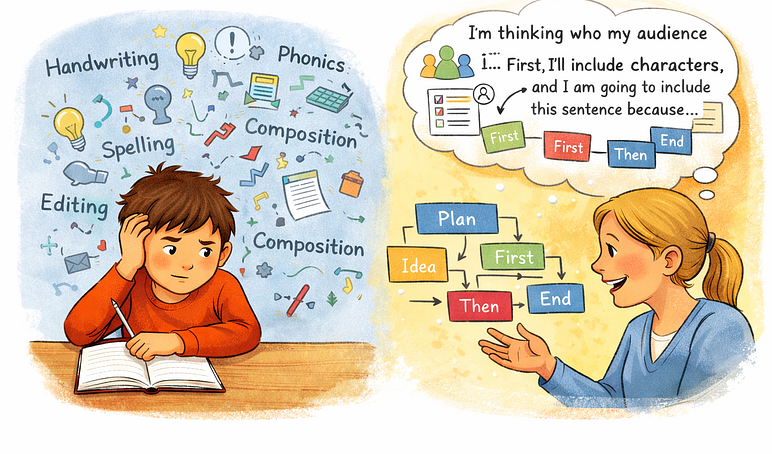
A staff meeting was planned for teachers to explore ways they could support TAs in understanding the underlying principles. Teachers chose to use ‘Think Alouds’ to explicitly model the underlying principles of the TA scaffolding framework (Bosanquet, Radford, and Webster, 2016), whilst applying it in the classroom with the pupils. E.g., ‘I am encouraging this group of pupils to self-scaffold because I know they know how to plan to approach the task. So, I am observing, and giving this group time for processing and thinking’.
Through classroom based training, TAs built upon their professional development without being taken out of the classroom. Staff united on implementation (Sharples, Eaton and Boughelaf, 2024) and teachers became more confident and competent in working alongside their TAs.

But what about the fox?
So how do we train small school TAs to remove a fox out of a reception classroom toilet? I’m afraid there is no evidence for that one, so I will have to leave it to your imagination! As I said earlier in the blog, small school leaders are highly creative!
References
Bosanquet, P., Radford, J. and Webster, R. (2016) The teaching assistant’s guide to effective interaction: How to maximise your practice, published by Routledge.
EEF (2025), Deployment of Teaching Assistants Guidance Report, The Education Endowment Foundation
Sharples, J., Eaton, J. and Boughelaf, J., (2024). A School’s Guide to Implementation Guidance Report. Education Endowment Foundation.
This website collects a number of cookies from its users for improving your overall experience of the site.Read more