Blog
Secondary
problem solving
•maths
Problem solving is everywhere, 25-30% of the time.
In this blog Kelly Duke considers the rise of problem solving within maths and how to move forward.
North Yorkshire Coast Research School
—
Blog
When too many processes compete for their attention and create real barriers to success, how can we support struggling writers?

Share on:

by North Yorkshire Coast Research School
on the

Assistant Director of North Yorkshire Coast Research School
Angie is a secondary English Teacher who also leads the SCITT and is a Curriculum and Research lead The Educational Alliance (TEAL), In addition, Angie is a Learning Behaviours content lead for the EEF
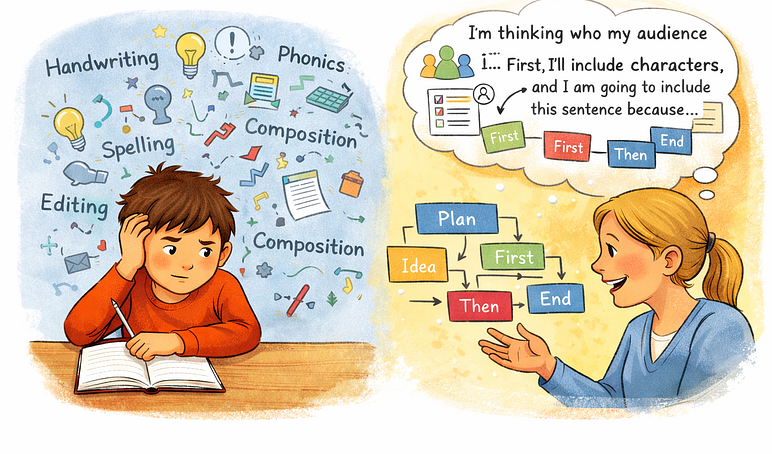
For many of our pupils, — especially those with limited background knowledge, our children who are socio-economically disadvantaged and struggle with writing, or younger learners in mixed age classes — the demands we place on working memory during challenging tasks such as writing can quickly become overwhelming. When too many processes compete for attention, pupils struggle to plan, organise, and retain ideas, creating real barriers to success.
Meet Matthew
Matthew is a thoughtful child who loves sharing his ideas aloud. But the moment he is asked to write, everything changes. His shoulders tense, his confidence dips, and the fluent talker becomes a hesitant writer. He explains:
His final comment is perhaps the most revealing: he simply “doesn’t like writing.”
Matthew’s teacher, Mrs Harrison, has noticed this pattern for some time. During writing tasks he often appears frustrated, embarrassed, and at times completely overwhelmed. What Matthew describes is a classic example of working memory overload: generating ideas, organising them, remembering the goal of the task, forming sentences, handwriting — all happening simultaneously. This is precisely where metacognitive strategies can make a meaningful difference.
Many of us teach pupils just like Matthew who have a wealth of rich ideas but struggle to map their thoughts down. They have ideas, imagination, and oral fluency — but the moment they are poised to write – pen in hand ‑everything seems to fall apart. The new EEF metacognitive strategies prompt tool gives us a sharper, more granular framework for supporting pupils through the stages of planning, monitoring, and evaluating their writing.

Goal Setting: Reducing Cognitive Load Before Writing
The EEF guidance emphasises the importance of teaching pupils to set realistic learning goals before working on tasks, noting that these can relate to “the learning process, desired outcomes, and acquisition of skills.”
For a pupil like Matthew, goal setting can act as a stabilising anchor, and as Mrs Harrison notices, it seems to motivate and engage him in the writing process. Instead of facing the amorphous challenge of “write a paragraph,” he can be guided to set small, manageable goals such as:
Today my goal is to choose three key ideas I want to include.
My goal is to write one clear sentence before I move on.
My goal is to use the plan I created to stay on track.
By narrowing the focus, we reduce the number of competing demands on working memory. Matthew no longer has to juggle everything at once; he has a clear, purposeful starting point.
Mrs Harrison also knows that Matthew struggles to gather his ideas; like most learners he will not spontaneously develop all the strategies he needs or would find useful and therefore initially Matthew requires explicit instruction in the key metacognitive strategies:
Activating prior knowledge & Gathering Ideas
Pupils should be taught how to recall strategies that previously helped or hindered learning, and how to apply this knowledge to plan approaches to new tasks.
For Matthew, he might reflect on the following:
Have I seen a task like this before?
What steps are needed to help me do this task?
What did I do last time? Have I created a mind map before?
Gathering Ideas
What was my goal again? What ideas do I need to collect?
Where could I get ideas? (different sources: books, experiences, pictures, prompts, peers)
How will I remember my ideas?
On reflection, Mrs Harrison realises that pupils benefit when teachers explicitly model the thinking processes behind writing — not just the final product. Matthew needs to see and hear what successful writers do inside their heads.
Ultimately, as teachers we need to ask ourselves, how consistently and explicitly do we make the ‘hidden’ cognitive processes of writing visible to our pupils? We need to consider to what extent we explicitly model the planning, monitoring, and evaluating processes required for developing self‑regulated writers — and where might greater intentionality help pupils like Matthew manage their working memory more effectively?
References
Siew and Nor (2019) Supporting Preschool Children’s Early Writing with Self-Regulated Learning Strategies
Education Endowment Foundation (EEF). Metacognition and Self-Regulated Learning(updated guidance report).
This website collects a number of cookies from its users for improving your overall experience of the site.Read more