Blog
Primary
Mathematical problem solving: space for struggle

Research Schools Network
—
Blog
How curriculum continuity can help sustain confidence and attainment
Share on:

by Research Schools Network
on the

Derby Research School
Amy is Director of Derby Research School and Director of NPQs for Spencer Teaching School Hub.
In this blog, Amy argues effective curriculum design can help pupils avoid the ‘transition dip’ between primary and secondary school.
As children move from primary to secondary school in England, there can be a concerning dip in mathematical attainment and attitudes towards maths. We often talk about the “transition dip” in mathematics as though it were inevitable, a natural consequence of moving from primary to secondary school. But what if this dip is not a certainty, but a signal?
A signal that something, somewhere, is misaligned.
Because when we look more closely at the evidence and, crucially, at pupils’ lived experiences, a different picture emerges. Transition in mathematics is not inherently problematic. It becomes problematic when continuity is lost: in curriculum, in relationships, and in expectations.
The challenge, then, is not simply to manage transition, but to design it better.
What does the evidence tell us about transition?
The Education Endowment Foundation (EEF) highlights that effective transition depends on careful attention to culture, curriculum and connections. When these elements are aligned, pupils are more likely to sustain both attainment and confidence. When they are not, pupils can struggle to adapt to new routines, expectations, and relationships.
The EEF’s School Transitions Tool sharpens this further, framing transition as a “trio of challenges”:
These challenges are not abstract, they are experienced daily by pupils in classrooms.
And it is here, in the lived experience of learners, that the most valuable insights lie.
What are pupils telling us?
At Derby Research School, working in collaboration with Spencer Academies Trust, the East Midlands West Maths Hub, and Inspiring Leaders, we explored how pupils experience the transition from KS2 to KS3 in mathematics through a close-to-practice research project.
The project focused particularly on underserved pupils — those whose outcomes are shaped not by ability, but by unequal access to opportunity.

A consistent message
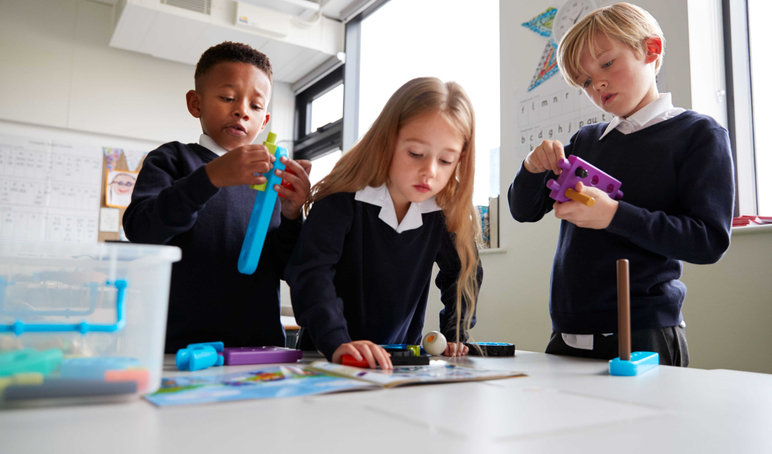
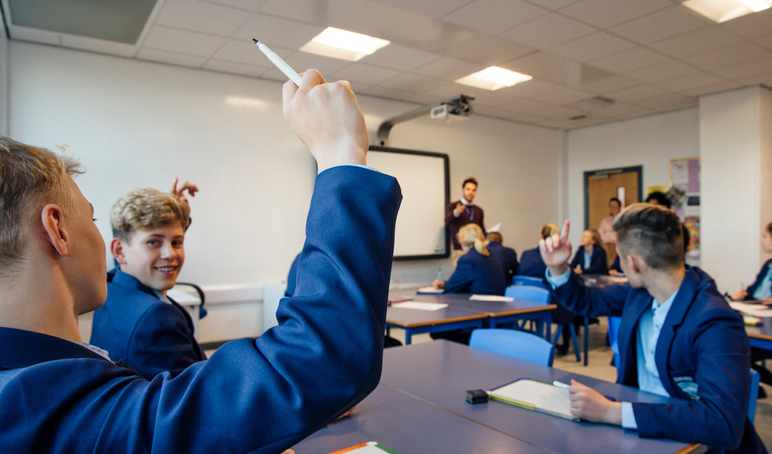
Pupils described Year 6 as a place of familiarity, support, and confidence. In contrast, Year 7 was often characterised by uncertainty: new routines, faster pacing, unfamiliar mathematical representations, and a reduced sense of being known.
Across all participating schools, pupils’ confidence declined following transition — regardless of prior attainment. But this dip was not simply about difficulty. It was shaped by discontinuity.
Curriculum: building on what pupils already know
One of the most significant sources of discontinuity lies in the curriculum.
Pupils frequently described encountering mathematics in new forms in Year 7:
This shift can contribute to cognitive overload, making it harder for pupils to connect new learning to what they already know.
Yet, where schools prioritised curriculum continuity — through shared representations, aligned language, and coherent sequencing — pupils experienced a much smoother transition.
Rather than reteaching content, teachers were able to extend it.

This reflects a central EEF principle that learning is most effective when new knowledge builds “on pupils’ existing knowledge and understanding” (EEF, 2022). Seen in this light, transition is not a starting point, but a continuation.
Looking ahead…
Pupils’ experiences of transition are shaped just as powerfully by relationships, expectations, and the structures we put in place around them. In our next blog, we explore how connections, culture, and key structural decisions, such as grouping, can either reinforce disruption or create the conditions for a successful transition.
This website collects a number of cookies from its users for improving your overall experience of the site.Read more