12 Nov - 20 Apr
online
Research School Network Evidence Advocacy Webinar Programme
A FREE six webinar series

Devon Research School
—
Blog
Hannah Claydon speaks to Jenny Trought, Kingsbridge Community College’s Secondary Intervention Teacher

Share on:

by Devon Research School
on the

Secondary Intervention Teacher, Kingsbridge Community College
Jenny Trought has been working at Kingsbridge Community College since September as a newly appointed Secondary Intervention Teacher. She has been working with Year 7 students who need additional support and brings a wealth of experience as a primary teacher to the school.
The newly published Education Endowment Foundation’s Guide to Inclusive Teaching states that inclusive teaching is about helping every child to participate and succeed in school. While this is particularly important for pupils with additional needs, it is closely linked to another key priority: improving outcomes for socioeconomically disadvantaged students.
The guidance describes inclusive teaching as both a challenge and an opportunity. It challenges us to think carefully about how we support pupils who find learning hardest, while also offering the opportunity to improve outcomes for all students through stronger teaching, collaboration and professional expertise.

Recently, I sat down with Jenny Trought, Kingsbridge Community College’s Secondary Intervention Teacher, to discuss how these principles are being put into practice with our new Year 7 students.
Identifying Need Early
Jenny brings a wealth of primary teaching experience and is working exclusively this year with Year 7 students who need additional support to access learning successfully in the mainstream secondary classroom.
Jenny works closely with our SENDCO and Team Leaders for English and Mathematics to identify the pupils most likely to benefit from intervention. Decisions are informed by a range of evidence, including Key Stage 2 SATs data, information shared by primary schools, SEND records and feedback from class teachers during the first few weeks of term.
This reflects one of the EEF’s key recommendations for effective intervention: support should be carefully matched to pupils’ specific needs rather than providing a generic solution.
Small Groups, Targeted Support
The EEF highlights that targeted interventions can provide valuable opportunities for pupils to receive high-quality support at greater intensity. However, effective interventions are carefully structured, regularly reviewed and focused on addressing specific barriers to learning.
Our Year 7 students attend intervention sessions in groups of between two and seven, usually for two or three sixty-minute sessions each week. The programme runs across a twelve-week curriculum cycle. At the end of the cycle students may continue with their intervention work, or return “full-time” to their mainstream lessons.
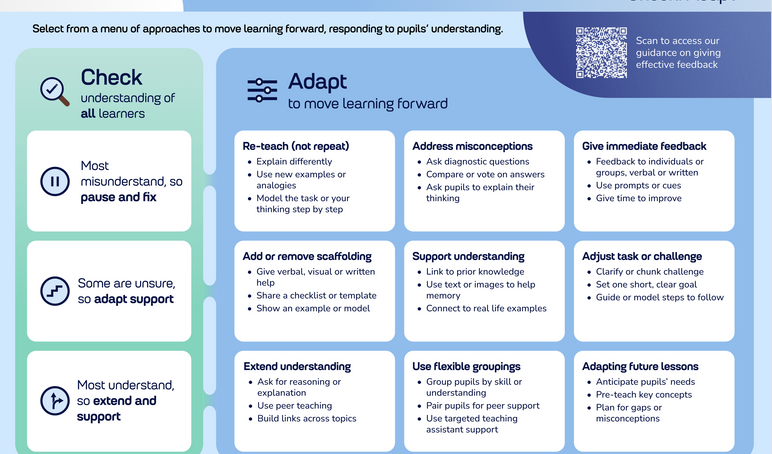
Jenny’s work exemplifies the guidance recommendations – small group teaching allows misconceptions to be identified quickly, provides opportunities for regular feedback and gives students the confidence to ask questions they may be reluctant to raise in a larger classroom environment.
Keeping Intervention Connected to the Classroom
For me the most striking aspect of Jenny’s work is how closely intervention is linked to what students are learning in their mainstream lessons.
In mathematics, students are pre-taught key concepts that will support future learning. For example, developing confidence with negative numbers and counting can strengthen their understanding of algebra when they encounter it in class, as well as a host of other topic areas they will come to learn.
In English, their focus is on sentence construction. Students are developing their ability to communicate ideas clearly and accurately, supporting success across a range of curriculum tasks. While Year 7 students are studying Animal Farm in their mainstream lessons, Jenny uses the same story as a vehicle for practising these foundational writing skills.
The goal is not to deliver a separate curriculum. Instead, intervention acts as a bridge, helping students access and succeed within the curriculum their peers are studying.
Familiar Routines Build Confidence
The connections do not stop with curriculum content. Jenny has deliberately designed sessions to mirror the structure of lessons across the college, incorporating familiar routines such as Do It Now activities, chunked learning and clear exit routines (the latter aligning with our college CPD program).
These consistent approaches help students feel more confident when returning to their mainstream lessons. For many pupils, particularly those who may have struggled during the transition to secondary school, familiarity reduces uncertainty and supports engagement with learning.
The Value of Primary Expertise
I was particularly interested in how Jenny’s experience in primary education influences her work.
“I always think, ‘How would I deliver this to a Year 6 student and what do I need to change to make it suitable for a Year 7 now they are a year older?’ ”
Her understanding of how concepts are taught in primary schools, and of the experiences many students bring with them into secondary education, helps her identify potential gaps and build effectively on prior learning. This knowledge provides an important bridge between the two phases of education.
Inclusion as Opportunity
Our conversation reinforced an important message of our college values, and from the EEF guidance: effective inclusion is not about creating something separate from excellent teaching. It is about identifying barriers, providing carefully targeted support and ensuring students can fully participate in their curriculum.
For socioeconomically disadvantaged students, this matters enormously. When interventions are evidence-informed, closely aligned with classroom learning and delivered by skilled practitioners, they can help remove barriers that might otherwise limit opportunities. Most importantly, they help ensure that every student has the chance not only to access learning, but to thrive.
References
Education Endowment Foundation (2026). The EEF Guide to Inclusive Teaching. Available at: https://educationendowmentfoun…
12 Nov - 20 Apr
online
A FREE six webinar series
Devon Research School
This website collects a number of cookies from its users for improving your overall experience of the site.Read more