23 Sep - 30 Sep
online
Check. Adapt: using adaptive teaching in mathematics
A 2‑part webinar aimed at teachers of Key Stages 2 to 4 and maths leaders

Blackpool Research School
—
Blog
Teachers are busy, but sometimes doing more can take less time and effort than doing less

Share on:

by Blackpool Research School
on the
Adapt Maths Wirral is a partnership between Blackpool Research School, the Education Endowment Foundation, and Wirral Council. It aims to reduce the gap in attainment in Key Stage 2 and Key Stage 3 maths between pupils from disadvantaged backgrounds and their peers.
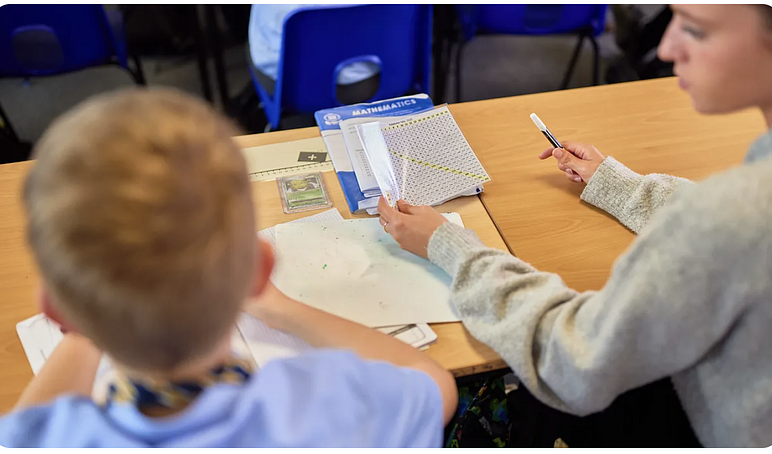
As the class worked on finding the area of compound shapes, Mr Harrison noticed Jack struggling and getting frustrated.
Not wanting Jack to become disheartened, he went to his desk and picked up a worksheet he had prepared for just this scenario. These questions contained only rectangles, as he knows Jack successfully solved problems like these recently.
“I can see you’re finding this tricky, so let’s just focus on these today, Jack,” Mr Harrison said, lowering the cognitive challenge. Approaching the teaching assistant, he asked “Sarah, could you sit with Jack please and guide him through this?”.
With the TA anchored to Jack, the teacher circulated the rest of the class — leaving his highest-need pupil without his expert input.
Offering less
Given teacher workload challenges, talk of teachers doing ‘more’ is often, and rightly, challenged. But when considering adaptive teaching, doing ‘more’ doesn’t always mean additional work – in fact, it can often mean less.
Take the example in our opening vignette. Mr Harrison’s intentions are clearly good, aiming to support Jack by providing an alternative task that reduces the cognitive demand. But adaptations such as this can reduce thinking, and this often has the unintended consequence of reducing learning too. By allowing Jack to skip the more challenging task of finding areas of compound shapes and return to his comfort zone of finding areas of rectangles, Mr Harrison has inadvertently exacerbated his challenges. And by offering Jack less, Mr Harrison has had to do more, spending time prior to the lesson planning and preparing an additional worksheet.
Ineffective adaptations often involve less:
Offering more
When considering what more effective adaptations might look like, we should have in mind that, to a great extent, good teaching for pupils with SEND is the same as good teaching for all.
In maths, this is likely to involve the use of worked examples, additional ‘think aloud’ modelling using a visualiser, the use of representations and manipulatives that support pupils in understanding mathematical structure, or the use of a checklist for more procedural tasks. If additional support is needed, this should include just as much, if not more, time with the teacher than the other pupils in the class receive.
As Greenshaw Research School mentioned in their recent blog, identifying which of these techniques to use and when to use it is more a mindset than a set of strategies, involving noticing, interpreting and responding to the shifting demands of the classroom without lowering ambition.
More effective adaptations often involve more:
Revisiting the vignette
As the class worked on finding the area of compound shapes, Mr Harrison noticed Jack struggling and getting frustrated. Not wanting Jack to become disheartened, he grabbed a mini-whiteboard, determined to scaffold the task without lowering the cognitive challenge. He knew Jack could already calculate the area of rectangles – he just needed a bit of extra support to master the new content.
“Let’s look at this together, Jack,” Mr Harrison said, using a worked example on the whiteboard very similar to the task Jack was working on. He modelled how to use a dashed line to split the compound shape into two familiar rectangles, thinking aloud as he deduced the missing side length. Catching the teaching assistant’s eye, he said, “Sarah, could you please circulate and monitor the rest of the class for the next few minutes while I work through this with Jack?“
With the TA keeping the rest of the room focused, the teacher directed his expert input exactly where it was needed most — guiding Jack until he was ready to succeed on his own.
There will be more details on the implementation of these techniques across Wirral schools in our case study blogs coming next academic year.
References
Education Endowment Foundation, 2017. Improving Mathematics in Key Stage 2 and Key Stage 3 guidance report.
Education Endowment Foundation, 2021. Teacher Feedback to Improve Pupil Learning guidance report.
Education Endowment Foundation, 2026. Checking for understanding that leads to action: adaptive teaching [blog].
Greenshaw Research School, 2026. Adaptive Expertise: more a mindset than a set of strategies [blog].
23 Sep - 30 Sep
online
A 2‑part webinar aimed at teachers of Key Stages 2 to 4 and maths leaders
Blackpool Research School
This website collects a number of cookies from its users for improving your overall experience of the site.Read more