Blog
Cross-phase
Making Concepts Clear: Choosing Examples and Non-examples for Inclusive Teaching
Explore how carefully chosen examples and non-examples can make new concepts clearer and more accessible for all pupils.
Claire Williams
—
Blog
This blog explores three reasoning routines that help pupils engage with the same mathematical ideas at different depths.
Share on:

by Alexandra Park Research School
on the

Mike has taught for 14 years and leads Maths at Alexandra Park Primary School. A Mastery Specialist, NCETM Lead, and White Rose Champion Teacher, he is passionate about making maths accessible and inspiring for all learners through evidence-informed practice.
If you walked into my classroom, there’s a fair chance you’d hear pupils discussing questions such as:
At first glance, these might not seem particularly revolutionary. They are all fairly simple prompts. However, the more I’ve used them, the more convinced I’ve become that they are some of the most powerful tools we have available to us in mathematics.
The reason is simple: they create multiple points of entry into the same mathematical thinking.
Take this example:

A pupil who is less confident in mathematics might suggest:
Neither response is wrong. Both require the pupil to notice something and justify their thinking.
Meanwhile, a pupil with a deeper understanding of number may notice:
The beauty of the task is that both pupils are participating in the same mathematical discussion. One pupil may be operating at a more sophisticated level of reasoning, but the other is still identifying patterns, noticing relationships and justifying their thinking.
The mathematics has not been differentiated. The thinking has.
This is where I think these routines connect particularly well with the EEF’s Guide to Inclusive Teaching.
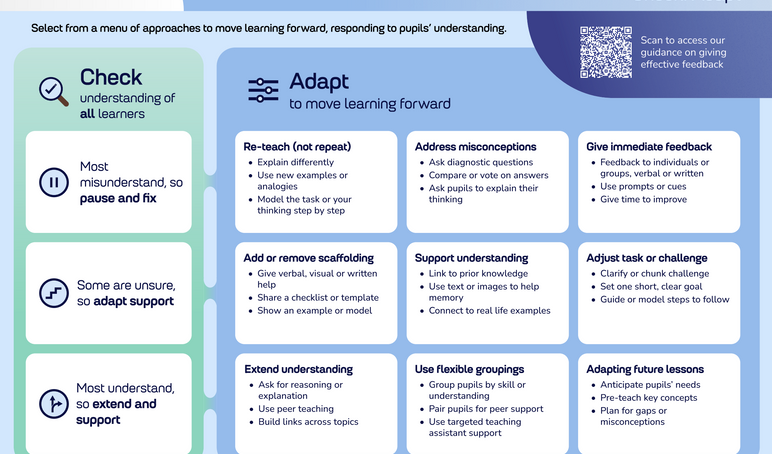
The EEF’s guidance emphasises helping every pupil to participate and succeed, while strengthening universal approaches that may be especially important for pupils with additional needs. For me, these routines offer one practical way to reduce barriers to participation without reducing the ambition of the mathematics.
Reasoning routines such as these can help to put that principle into practice.
The scaffold is built into the task itself. Pupils are not working on a simplified worksheet or completing a completely different activity. They are engaging with the same mathematical idea as everyone else. The difference lies in the depth of reasoning that emerges.
As the EEF notes, effective scaffolding should provide enough temporary support for pupils to succeed, while keeping an eye on how that support can be reduced as independence grows.
The same can be seen through What’s the Same? What’s Different?

Some pupils may immediately notice:
Others may go further:
Again, every pupil has a contribution to make. The task encourages comparison, discussion and connection making.
This is another area where the EEF’s Inclusive Teaching Guidance feels particularly relevant. Universal approaches such as explicit instruction include using examples and non-examples, checking understanding and connecting new learning to what pupils already know. Tasks that encourage pupils to compare, contrast and articulate mathematical structures can create space for exactly this kind of thinking.
Then there is Must, Could, Can’t.
Consider the following statements:

A less confident pupil might begin by generating examples to test the statements.
A more confident pupil might explain why they are true, search for counterexamples, consider whether the statements are always true or even move towards proof.
The task remains the same. The depth of thinking changes.
This also reflects another important principle within the EEF’s two-part model of inclusive teaching: strong universal approaches should sit alongside adaptations or additional support some pupils may need.
Inclusion should not be confused with making work easier. Rather, it is about ensuring that all pupils can meaningfully engage with challenging ideas.
Perhaps this is why I keep returning to these routines.
They embody so many of the principles associated with inclusive teaching:
Too often, inclusion and challenge are presented as competing priorities. In mathematics, I am increasingly convinced that the best reasoning activities achieve both simultaneously.
A pupil can offer a simple observation.
Another can construct a sophisticated mathematical argument.
Both are contributing.
Both are thinking.
Both are engaging with the same mathematics.
And perhaps that is what makes routines such as Which One Doesn’t Belong?, What’s the Same? What’s Different? and Must, Could, Can’t so effective. They do not lower the ceiling for the most able, nor do they raise the floor so high that some pupils struggle to participate.
Instead, they widen the doorway into the mathematics itself.
For me, that is what genuinely inclusive teaching looks like.
Education Endowment Foundation (2026), Guide to Inclusive Teaching
Education Endowment Foundation (2022), Scaffolding – more than just a worksheet
This website collects a number of cookies from its users for improving your overall experience of the site.Read more