Blog
Cross-phase
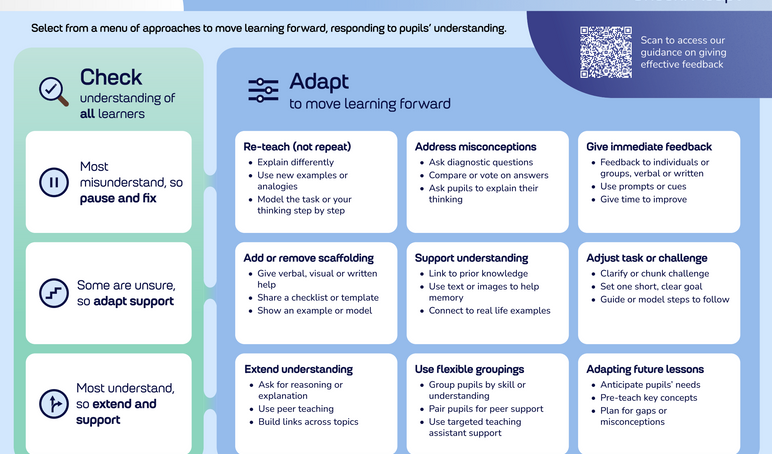
Reteach, Don’t Repeat: When the First Explanation Doesn’t Land
Reteaching that works: why repeating explanations fails and how to adapt teaching to secure understanding
Claire Williams
—
Blog
Explore how carefully chosen examples and non-examples can make new concepts clearer and more accessible for all pupils.
Share on:

by Alexandra Park Research School
on the

Jennifer is Assistant Director of Alexandra Park Research School and Trust Lead for Early Career Teacher Development at The Greater Manchester Education Trust.
Picture the scene. Your class are struggling with a new concept. You’ve explained the characteristics of a mammal, but some pupils still aren’t getting it. What do you do next?
What examples could bring this concept to life, help pupils notice its critical features, and be accessible to every pupil in the room?
When introducing a new concept, teachers often start with a definition. But a definition on its own, whilst allowing pupils to understand the words within it, might not secure a deeper understanding of the concept itself. Selecting the right examples and non-examples to accompany a definition can support pupils to understand the critical features of a concept.
But if examples are to support inclusive teaching, we need to consider if the examples we choose are equally accessible to all pupils in the classroom.
The EEF Guide to Inclusive Teaching identifies explicit instruction as a universal approach that can benefit all pupils. The use of examples and non-examples is a key aspect of explicit instruction, particularly when introducing new ideas to pupils, and can be especially beneficial for pupils with additional needs.
Why might the use of examples be so important?
Because they can connect new learning to prior knowledge.
“We understand new things in the context of things we already know, and most of what we know is concrete.”
This means we have to carefully consider the prior knowledge pupils may already have. Because if our example relies on vocabulary, background knowledge or experiences that some pupils do not possess, we risk creating an additional barrier to understanding.
Consider the concept of a mammal.
Definition:
A mammal is a warm-blooded vertebrate animal that has hair or fur and whose females produce milk to feed their young.
Critical features:
Vertebrate, Warm-blooded, Hair or fur, Produces milk

1. Use more than one example
Choose a range of examples so pupils see the concept in different ways and do not overgeneralise from a single example.
2. Connect to what pupils already know
An example cannot help pupils understand a new concept if they need additional knowledge to understand the initial example.
3. Make the critical features visible
Use examples that help pupils understand the critical features of the concept.
Non-examples help pupils understand what a concept is by understanding what it is not.
1. Use non-examples that are similar
Select non-examples that are different from the examples in a small way. This draws attention to the critical features and helps pupils understand the boundary of the concept. If the non-example is significantly different, there is a risk that pupils simply identify the ‘odd one out’ rather than focusing on the critical features.
2. Compare examples and non-examples side by side
Present them alongside one another so pupils can identify similarities, differences and the critical features of the concept.
3. Anticipate misconceptions
Choose non-examples that expose common misconceptions, allowing these to be addressed before they take root.
Willingham, D. T. (2009). Why Don't Students Like School?
Tharby, A. (2018). How to Explain Absolutely Anything to Absolutely Anyone: The Art and Science of Teacher Explanation.
Education Endowment Foundation (2026). A Guide to Inclusive Teaching.
This website collects a number of cookies from its users for improving your overall experience of the site.Read more