Blog
Cross-phase
We've Got the Whole Child in Our Hands
Using Strong Relationships to Inform Pupil Premium Strategy and Implementation
Tudor Grange RS
—
Blog
Boosting Whole-School Vocabulary and Fluency at Key Stage Three

Share on:

by Tudor Grange Research School
on the

Laura is Head of English at The Stourport High School, a school which participated in the Worcestershire EEF Partnership – Transforming the leadership of disadvantage and the leadership of Literacy.
As a secondary school, we know pupils move quickly from ‘learning to read’ in primary school to ‘reading to learn’ across a curriculum filled with challenging academic texts. However, when we assessed reading ages across Key Stage Three, we found a significant gap between many pupils’ reading ability and the demands of the secondary curriculum, where a reading age of fifteen years and seven months is needed to fully access GCSE examination texts. As many as 56% of pupils had a reading age below their chronological age. This raised an important question: although pupils encountered texts throughout the school day, were they reading them with sufficient fluency and understanding to learn from them?
We examined how reading was taught across the school and identified gaps in vocabulary knowledge and reading fluency that were limiting pupils’ access to the curriculum. Although pupils encountered a range of texts each day, the extent to which they could access them varied. For some, the time spent actively reading was far less than during Key Stages One and Two, where explicit reading instruction is prioritised.
As a starting point, we followed the recommendations in the Education Endowment Foundation’s Improving Literacy in Secondary Schools
guidance report by prioritising vocabulary instruction across all subjects. Supported by Alex Quigley’s Closing the Vocabulary Gap and training from the EEF’s Worcestershire Leading Literacy Project, we delivered training on pre-teaching vocabulary, focusing on bespoke definitions, immediate interaction and repetition. We then used curriculum twilight sessions for departments to map subject-specific vocabulary and develop resources using shared models.
Alongside this, we explored how to improve reading fluency in a secondary context. Through the Worcestershire Leading Literacy Project and peer coaching with colleagues from primary and secondary schools, we recognised that although most pupils arrived in Year 7 able to decode accurately, their comprehension could still be limited by weak reading fluency. Guided by Christopher Such’s Primary Reading Simplified, we understood that improving fluency reduces cognitive load, allowing pupils to focus more effectively on comprehension.
As part of our multi-academy trust, we visited a feeder primary school involved in the project and observed a Key Stage Two reading fluency lesson. We then discussed strategies including teacher modelling, echo reading, choral reading, partner reading and whisper reading. We realised that if pupils were already familiar with these approaches in primary school, it made sense to build on them in Key Stage Three. This aligns with the EEF’s Reading Fluency guidance, which recognises that “While most pupils begin secondary school with the general skills and knowledge needed to read accurately, fluently and with comprehension, some do not.” and makes recommendations for building opportunities for reading fluency at KS3.
We began by training the English department in the reading fluency strategies we had observed and modelled their use. Working with a peer coach, we trialled these approaches with a Key Stage Three class, observing each other’s lessons and providing reflective feedback during the first half-term. We collated this feedback before embedding and refining the strategies throughout the Spring Term.
Lesson observations showed significantly higher levels of participation during reading activities, while internal assessment data indicated that pupils were more successful in accessing reading assessments following regular reading fluency lessons.
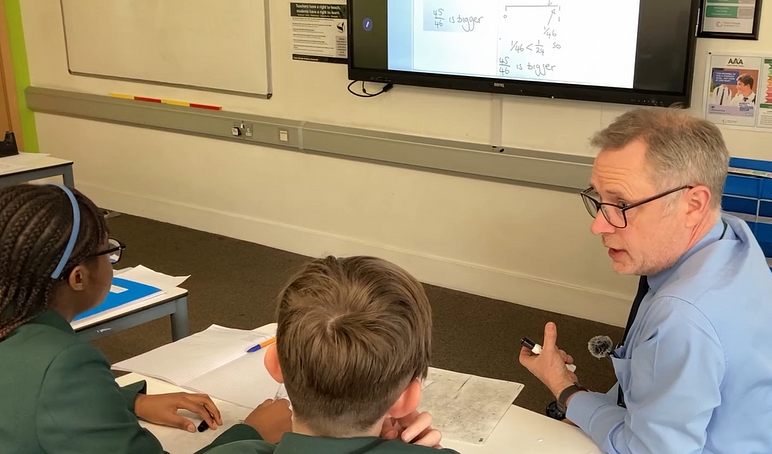
Our Summer Term professional development has focused on extending reading fluency training across the school. Following the EEF A School’s Guide to Implementation, we know that it is important to unite the team by ensuring that they fully understand the role that reading fluency plays in improving pupils’ learning in all subjects. We therefore adapted our training to demonstrate its relevance beyond English, including examples from subjects such as mathematics, where reading demands are less obvious.
The EEF’s Improving Literacy in Secondary Schools guidance, “challenges the notion that literacy in secondary school is solely the preserve of English teachers, or literacy coordinators,” and makes it clear that, “every teacher communicates their subject through academic language, and that reading, writing, speaking and listening are at the heart of knowing and doing Science, Art, History, and every other subject in secondary school.” Colleagues have therefore been given opportunities to practise reading fluency strategies with their own Key Stage Three classes and to take part in informal walkthroughs with the English department, where these approaches are now well established.
As a direct result of our participation in the EEF’s Leading Literacy Project, our next step is to embed pre-teaching vocabulary and reading fluency consistently across all subject areas while evaluating their impact on pupil outcomes. Our aim is that every pupil leaves Key Stage Three equipped to access the increasingly complex texts they encounter across the curriculum and beyond.
This website collects a number of cookies from its users for improving your overall experience of the site.Read more