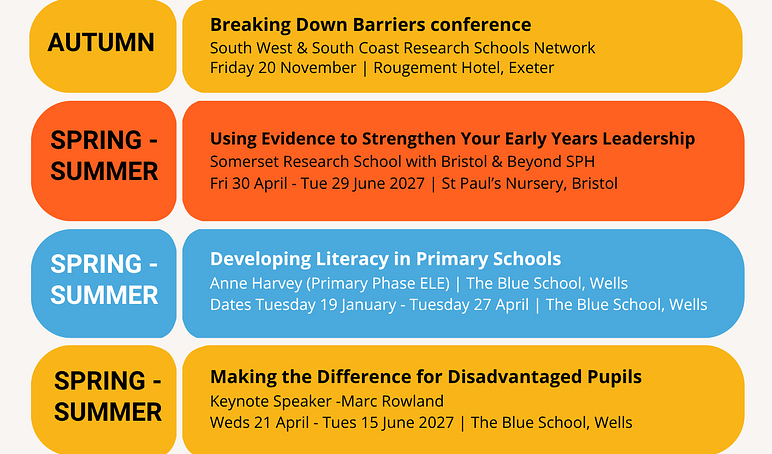
21 Apr - 15 Jun
in-person
Making the Difference for Disadvantaged Pupils
Supporting Disadvantaged leaders: What the evidence tells us

Somerset Research School
—
Blog
Universal approaches in Modern Foreign Languages

Share on:

by Somerset Research School
on the

Deputy Director Somerset Research School
This blog is written by Oliver Batten, Deputy Director of Somerset Research School. Oliver is also a teacher of MFL at The Blue School, in Wells.
What do we do, every day in MFL, that is especially important for pupils with additional needs?
The recently published EEF Guide to Inclusive Teaching refers to 5 key areas of universal teaching:
Calm Classroom Environments
Explicit Instruction
Positive Relationships
Feedback
Scaffolding
Good teaching for pupils with additional needs contains the same elements as good teaching for all
I would argue that, for students, the complexity of learning a new language requires MFL teachers to carefully deliver high-quality universal teaching approaches in the classroom. Learning another language can be incredibly daunting for students with additional needs and effective teachers will ensure that the right conditions are in place for all learners to engage fully with learning tasks.
At the heart of this, is making sure that there is a calm and positive atmosphere in the classroom, where participation, not accuracy is key. In this blog, I hope to outline some of the ways in which MFL teachers create classrooms that allow all students to thrive.
Students get their first attempt at using the target language when answering the register. A quick ‘Oui, Monsieur’ is a fantastic way to engage students with the idea that they will be using another language in your lesson, along with writing titles and dates in another language, which are clearly displayed on the board, if students need to refer to them.
A carefully considered, familiar lesson structure is also essential to reduce cognitive load. This can include typical retrieval practices such as low-stakes quizzing, followed by modelling practices using the ‘I do, we do, you do’ structure. In MFL lessons, there tends to be additional focus on modelling and repetition. Students often do not have opportunities to use other languages at home, and this is where repetition, drilling and choral response play a vital role in engaging learners. Through group participation, students can develop their pronunciation and confidence in a safe, fun and interactive way.
Through active engagement in learning activities, effective MFL teachers will praise students and give feedback in real time using quick comments or live-marking techniques. This reinforces expectations and encourages further participation. Teachers often do this in the target language and this gives students an opportunity to hear the language used in natural interactions. In addition, timely written feedback, especially after an assessed task allows students to grasp how well they have done and establish areas for development. Students are often given chances to redraft responses, level up and correct misconceptions once they have read their feedback.
Universal approaches give teachers a strong foundation to work from: they are a powerful starting point, not a script. Feedback and scaffolding, for example, are most effective when teachers draw on what they know about pupils’ starting points and anticipate where difficulties are likely to arise
MFL teachers must be adept at breaking down complex concepts and language. Explicitly teaching vocabulary is a key part of language teaching. Clear modelling of new language develops their sense of psychological safety, before expecting students to use it in other contexts. Some teachers check for understanding by using examples and non-examples (perhaps using Frayer Models or similar).

New vocabulary can also be supported with dual coding and writing frames.

Careful questioning will allow the teacher to quickly grasp if students have understood the key learning and if there is high accuracy/understanding in the class, the teacher can allow greater independence for those that are ready. A common way to assess comprehension would be to ask hinge questions and use mini-whiteboards to read the room quickly.

Good MFL teachers will start to scaffold the learning and reteach key points (if necessary), to ensure that all learners have access to the key concepts in the lesson/sequence of lessons. Anticipating some of the issues students will encounter, based on the teacher’s knowledge of their students, will no doubt lead to more effective learning from all. Giving these students opportunities to work independently once they too have grasped the learning will to allow all to thrive. Teaching Assistants will also be able to support the learning through scaffolding.

As always, the scaffolding offered to students will be faded over time, allowing students to engage in learning more independently, once they have gained additional confidence with the new concepts being used.
For further information and support with inclusive teaching practices, please visit the EEF website.
References
EEF Guide to inclusive Teaching: https://educationendowmentfoundation.org.uk/education-evidence/inclusive-teaching
EEF SEN in Mainstream Schools guidance report: https://educationendowmentfoundation.org.uk/education-evidence/guidance-reports/send
21 Apr - 15 Jun
in-person
Supporting Disadvantaged leaders: What the evidence tells us
Somerset Research School
19 May
online
his programme is based upon the recommendations from the EEF’s updated Deployment of TAs Guidance Report.
Somerset Research School
This website collects a number of cookies from its users for improving your overall experience of the site.Read more