Blog
Cross-phase
Teaching and learning
This Learning Is for You: Belonging as a Teaching and Learning Issue
Rachael Welsh
—
Blog
How a Whole-Cohort Reading Programme Supports Inclusive Teaching
Share on:

by Shotton Hall Research School
on the

Liv Farrell is an experienced secondary English leader, building progress in departmental and whole-school literacy development. She has most recently led on a trust-wide initiative to build whole-cohort literacy provision.

For many years, secondary literacy support has often focused on a relatively small number of pupils whose reading is significantly below age-related expectations. The implicit assumption has been that most pupils arrive in Year 7 as competent readers, with any remaining gaps addressed through targeted intervention.
Yet the reality in many classrooms suggests otherwise. While many pupils can decode accurately, they often struggle to read demanding curriculum texts with the fluency needed for successful learning. Faced with unfamiliar vocabulary, complex sentence structures and subject-specific language, pupils can quickly become overwhelmed. I think every teacher across the country has heard the most familiar of responses: “I don’t know.“
The challenge, therefore, is not simply identifying the weakest readers. It is recognising that reading fluency exists on a continuum and that many pupils would benefit from further development, regardless of whether they meet the threshold for traditional intervention. This aligns closely with the Education Endowment Foundation’s guidance on both literacy and inclusive teaching, which emphasises the importance of strong universal provision and recognises that support benefiting pupils with additional needs often improves outcomes for all learners.
With this in mind, at North East Learning Trust, we decided to move beyond a model centred solely on targeted intervention and instead develop a whole-cohort reading programme. Our goal was simple: to create a consistent approach that would improve reading fluency and provide every pupil with greater access to the curriculum. By explicitly modelling fluent reading, providing structured opportunities for practice and offering precise, actionable feedback, we aimed to turn “I don’t know” into “I can do it.”
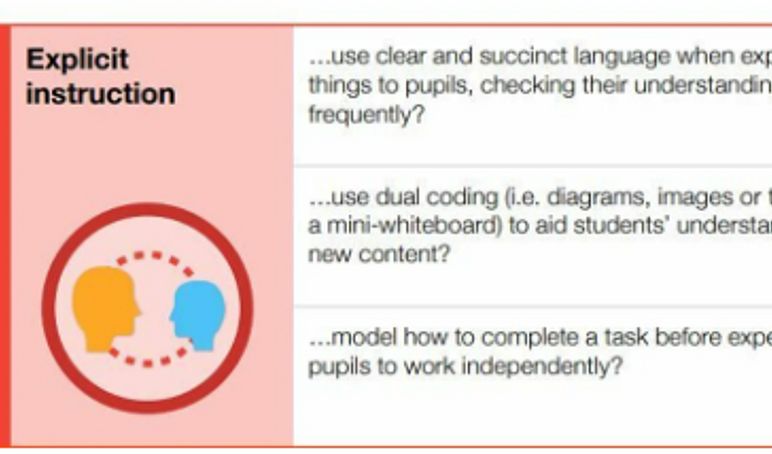
We chose to focus on developing a programme where prosodic reading was modelled extensively to students, with a view to increase their oral reading fluency. In the EEF’s Guide to Inclusive Practice, there is a strong focus on how explicit instruction should focus on ‘breaking complex…skills into small steps’, so with this in mind, we constructed our lessons to primarily be based around repeated reading, with texts broken into key phrases and sentences that were read aloud at least three times. Teachers demonstrate prosody, pacing and expression before pupils imitate the model. This reduces cognitive load, making expert performance visible all whilst providing a clear example of successful reading behaviours. This structured approach where pupils replicate teacher modelling aligns further with the report, where pupils practise new learning following explicit instruction. This repeated reading consolidates the key reading behaviours we want to see from students.
Alongside our explicit instruction and modelling, feedback plays a constant, central role. The EEF identifies how effective feedback should be specific, actionable and focussed on improvement. During students’ fluency practice, pupils receive precise guidance such as: “I liked the expression you used there; now try slowing down slightly at the comma” or “emphasise that key word to help convey meaning.” Rather than simply being told whether they have read well, pupils are shown exactly how to improve.
Why have we found this approach powerful? It supports inclusion through universal practice. Here, every pupil receives access to high-quality modelling, practice and feedback. The result: a classroom where pupils access challenging texts, participate confidently and firmly believe “I can do it”.
References
Education Endowment Foundation (2018). Improving Literacy in Secondary Schools: Guidance Report. London: EEF.
Education Endowment Foundation (2026). Guide to Inclusive Teaching. London: EEF.
This website collects a number of cookies from its users for improving your overall experience of the site.Read more