Blog
Primary
To set or not to set? That is the question…
By Victoria Begley, Deputy Director, London South Research School
London South Research School
—
Blog
By Emma Warsop, Assistant Headteacher Curriculum and Assessment, Year Two Teacher, Streatham Wells Primary School

Share on:

by London South Research School
on the

Assistant Headteacher Curriculum and Assessment, Year Two Teacher, Streatham Wells Primary School
With the attention oracy seems to be drawing currently in educational circles, readers will have a good understanding of what the term oracy means and even be able to recall some hard-hitting quotes and statistics that underpin its unmistakable value in developing our children. But for clarity’s sake, Oracy Cambridge defines oracy as, ‘the skills involved in using spoken language to communicate effectively.’ Even more simply put, we can think of oracy as communication skills.
Hopefully, if you’re reading this, you’re already won round on the premise that good oracy levels are crucial to a child’s success in school and beyond. I’m going to take a pragmatic stance: there is much that we can do to improve the standard of oracy in our schools. Yes, it might take a while, but there are lots of practical steps we can do now as educators and school leaders to get the ball rolling.
Rethinking how we teach and prioritise oracy will be a culture change. This is precisely why, at the beginning of any oracy journey, there needs to be an emphasis on winning over the teachers, who will ultimately be the ones doing the groundwork.
Auditing played an important role in the beginning of my oracy journey too, and I would urge other leaders to do the same. Pupils, staff, parents, teachers, senior leaders: gather all the voices! Do you have a culture of active listening? What are confidence levels in the teaching of oracy? What do teachers perceive as the barriers? What are the current standards of oracy? How well do staff model high standards of oracy and active listening? How is talk used currently in your setting?
It was in answer to this question, that my oracy journey really began. Talk was used as a filler; a way to get children to list out ideas, features or facts from the previous lesson. Discussions were often led by more confident speakers and the conversation was limited to recapping or giving opinions in turn.
In other words, most talk I observed and indeed used in my own classroom practice was ‘cumulative’ rather than ‘exploratory.’ These terms- rooted in Lev Vygotsky’s work on social constructivism, but introduced by Douglas Barnes in 1975 and developed later by Neil Mercer in Exploratory Talk, Disputational Talk and Cumulative Talk (Mercer, 1995) – became the basis of my oracy action plan.
What is Exploratory Talk?
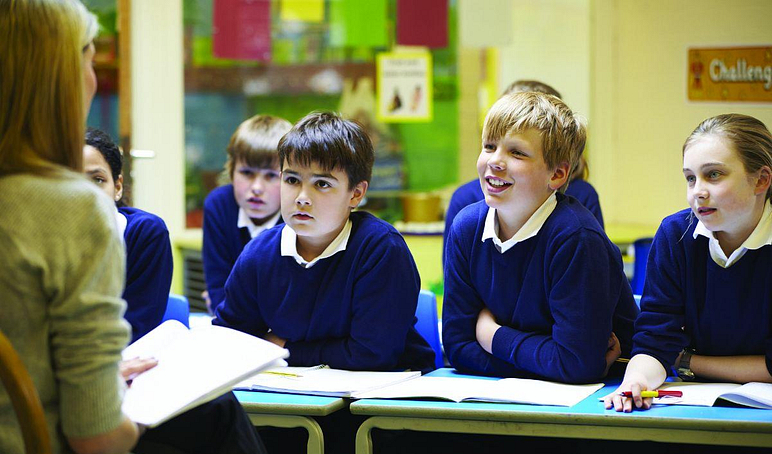
Exploratory talk refers to the type of discussion that moves learning forward. It is not merely peers sharing ideas, but rather when students listen critically but constructively. The end goal of these discussions is to come to an agreement rather than just listing and collecting ideas. Mercer (2008) characterises exploratory talk as discussions including but not limited to the following features:
- Everyone is encouraged to contribute
- Everyone listens actively
- People ask questions
- People share relevant information
- Ideas and opinions are treated with respect
- There is an atmosphere of trust
- There is a sense of shared purpose
- Contributions build on what has gone before
- People give reasons for their thinking
- Ideas may be challenged
- The group seeks agreement for joint decisions
Learning about exploratory talk and the rationale behind it really changed how I started to think about oracy in my own setting. Suddenly gaps, in otherwise seemingly productive lessons, were starting to be highlighted. Children were fully engaged in cumulative talk, with peers and their teachers (in other words they were waiting for the speaker to stop before giving their two penneth) but there was a wealth of missed learning opportunities. Not to mention instances where the teacher could have stopped talking, handed the reins over to pupils and ended up having a greater impact.
As stated in Dr James Mannion’s article for Oracy Cambridge, “In exploratory talk, the thinking, reasoning and critical engagement is tangible. The group interacts as a well-oiled unit, engaging in collaborative group discussion that is greater than the sum of its parts – like a ‘hive mind’.” (Mannion, 2020.)
I hope I’m not alone in admitting that achieving discussions in classrooms that resemble ‘a well-oiled unit’ is a colossal challenge. In achieving this, a wealth of foundations for good oracy need to already be embedded.
Helpful Resources
We Need To Talk
Guidelines for exploratory talk
The Oracy Skills Framework and Glossary
Voice 21 Talk Groupings
Talk Moves
Primary English Education Consultancy Progression Document
This website collects a number of cookies from its users for improving your overall experience of the site.Read more