Blog
Cross-phase
Prioritised, Not Categorised
Rethinking How We Talk About Pupil Potential
Hampshire Research School
—
Blog
Building a Consistent Approach at Front Lawn Primary School

Share on:

by Hampshire Research School at Front Lawn Primary
on the

At Front Lawn Primary School, we believe that manipulatives are essential tools for supporting mathematical understanding across all age groups. Whether in Early Years or Key Stage 2, hands-on resources help pupils engage with mathematical concepts in meaningful ways. Our consistent, whole-school approach to using manipulatives is rooted in the Education Endowment Foundation’s (EEF) guidance on improving primary mathematics, ensuring that every child benefits from concrete learning experiences tailored to their stage of development.

The Power of Manipulatives for Every Learner
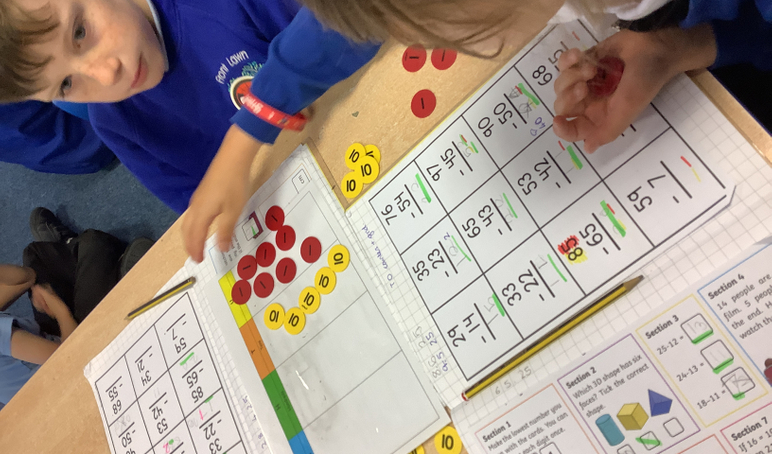
Manipulatives — physical objects like counters, number lines, base ten blocks, and Cuisenaire rods —are powerful tools that make abstract concepts tangible. The EEF highlights that manipulatives and representations can help pupils develop a deep understanding of mathematical ideas, supporting their progression from concrete experiences to abstract reasoning. Importantly, this approach is effective for pupils of all ages when used purposefully and thoughtfully.
In Early Years and Key Stage 1, manipulatives introduce foundational concepts such as counting, addition, and subtraction through exploration and play. As pupils progress into Key Stage 2, these tools evolve to support more complex ideas like fractions, decimals, multiplication, and division. By maintaining a consistent approach, we ensure that pupils continue to build on their prior knowledge, using familiar tools to deepen their understanding.

Our Whole-School Approach to Manipulatives
To embed the effective use of manipulatives across all year groups, we have developed a structured, consistent strategy that aligns with the EEF’s recommendations:
Overcoming Misconceptions
One common misconception is that manipulatives are only suitable for younger or lower-achieving pupils. However, the EEF guidance makes it clear that all pupils benefit when manipulatives are used appropriately. At Front Lawn, we challenge this myth by embedding manipulatives in lessons across all abilities and age groups. Whether supporting problem-solving, reasoning, or fluency, these tools help all learners develop a deeper, more connected understanding of mathematics.
The Impact of a Consistent Approach
Our whole-school commitment to using manipulatives consistently has led to increased pupil engagement and confidence in mathematics. Pupils are more willing to explore challenging concepts because they have the tools to visualise and make sense of their learning. Teachers report that this approach has not only supported understanding but has also improved problem-solving skills and mathematical reasoning.
Looking Ahead
As we continue to develop our mathematics curriculum at Front Lawn Primary School, manipulatives will remain a core component of our teaching strategy. By aligning our practice with the EEF’s evidence-based guidance and maintaining a consistent approach across all year groups, we are confident that our pupils will continue to build strong mathematical foundations that will support their learning for years to come.
Manipulatives are not just tools for early learning — they are lifelong learning aids. With thoughtful planning and consistent use, they empower pupils of all ages to engage deeply with mathematics and develop a genuine understanding of the subject.
This website collects a number of cookies from its users for improving your overall experience of the site.Read more