Blog
Primary
maths
•automaticity
•retrieval
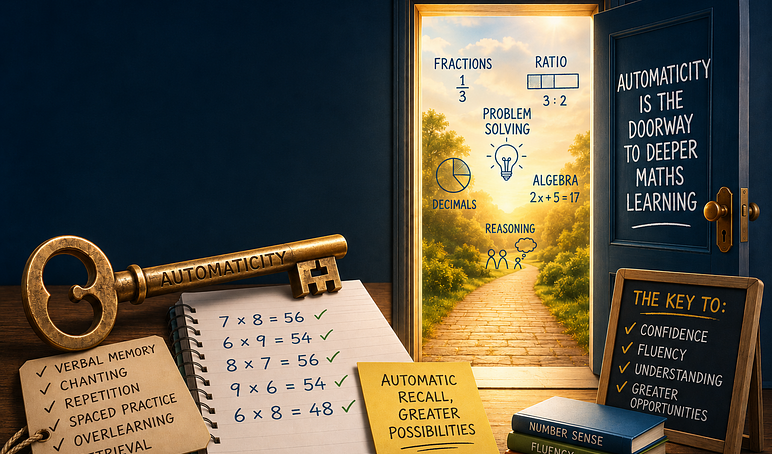
Why Automaticity in Mathematics Matters as Much as Phonics in Reading
Can verbal memory help all pupils achieve automatic recall of multiplication facts?
Jessica Mellor
—
Blog
How stem sentences and choral response support participation, understanding, and recall

Share on:

by Great Heights Research School: West Yorkshire
on the

Trinity Academy Leeds
Jenny Burrage is a Lead Teacher of Maths at Trinity Academy Leeds and an NCETM Teaching for Mastery Specialist. Trinity Academy Leeds is located in the Burmantofts area of Leeds, 61% of pupils are eligible for Pupil Premium funding. The proportion of pupils who speak English as an additional language is above the national average.
When I first started teaching, I used to think that I was helping students if I used easier vocabulary to explain mathematical ideas. However, I have seen that the opposite is true. When vocabulary is explicitly taught through repetition and use of the word, students can both use and understand tier 3 vocabulary. One way I encourage this practice and repetition is through choral response. This is a technique I have used more and more and the reasons are two-fold: it increases participation, keeping students engaged and thinking more; and it promotes recall of key vocabulary and concepts (Mccrea, 2024). This gives students the vocabulary they need to explain their ideas and understanding.
Increasing engagement
In terms of participation, our ideal as teachers is to have all students listening and thinking throughout the lesson. This is difficult to ensure in practice, but if students know that they can be expected to answer chorally at any moment, and not just a one in 30 chance they are called on through cold call, they are more likely to be listening, and therefore thinking about the questions you pose.
Below is a recent example when teaching percentages of amounts to a lower-attaining year seven group. We were using a ratio table supported by bar models to understand why we divide by two for 50% and divide by two again for 25%. We were working out 25% of £240. Here is an idea of the dialogue:

Promoting and building confidence in mathematical language
Choral response also aids recall and builds confidence in mathematical language. Lee (2006) describes students’ reluctance to use mathematical vocabulary and the need for pupils to learn to express their mathematical ideas. I noticed this when I visited a class that were learning about corresponding angles. Every student had correctly worked out the size of the angle and had written it on their mini-whiteboards. The teacher asked them to turn and talk and explain their reasoning to their partner. There was not much chatter at all, unusual for the group. The teacher then instructed them to write their reason instead. All students wrote corresponding angles, putting it into various sentences or just writing those key words; they had lacked the confidence to put it into a sentence, one that almost all maths teachers would express in the same way: “corresponding angles are equal”.
‘Proficiency in mathematics depends on a continuous growth and blend of intricate combinations of critical component skills such as concepts, procedures, algorithms, computation, problem solving, and language.’ (Riccomini, Sanders, & Jones, 2008).
Since my classroom visit outlined above, I now use choral response throughout parallel line facts (and anywhere a standard sentence is used). I will often interleave it with individuals’ responses to boost retrieval opportunities. For example, if a student has narrated their calculation e.g. 180 – 35 = 145, I will ask the class, “what is the reason for using 180?” Students: “angles on a straight line sum to 180”. This not only helps with their confidence to verbally use the language, but also in written examinations when asked to ‘Give a reason for your answer’
The NCETM’s Oracy in Mathematics Framework (NCETM, 2025) highlights the importance of students learning to talk and learning through talk. Choral response, mixed with opportunities for students to narrate their thinking and understanding in both individual responses and pair talk, allows both types of talk to happen.
Choral response gives students confidence in a vocabulary and how to use it, while paired talk and individual questioning, provides the opportunity to make the mathematical language their own.
References
Lee, C. (2006). Language for Learning: Mathematics. Open University Press.
Mccrea, P. (2024). Choral Response: Laying the groundwork for elaboration. Retrieved from Evidence Snacks: https://snacks.pepsmccrea.com/…
NCETM. (2025). Oracy in mathematics framework. Retrieved from NCETM: https://www.ncetm.org.uk/teach…
This website collects a number of cookies from its users for improving your overall experience of the site.Read more