23 Mar
in-person
Exploring SEND Strategies – Booking Closed
Thorough explore of rec. 1 and 2 from the guidance, how we apply this to our classrooms and bring parents with us.

Gloucestershire Research School at The GLA Trust
—
Blog
The second step of how a strategy can move from vision to live teaching
Share on:

by Gloucestershire Research School at The GLA Trust
on the

Alex Trainer is assistant headteacher for teaching and learning at Churchdown School Academy, a secondary school in Gloucestershire.
My last blog post discussed how to create a vision for a strategy to teach Tier 2 vocabulary. This post reflects on the first phase of implementation, focusing on how the strategy moved from vision to a live teaching strategy.
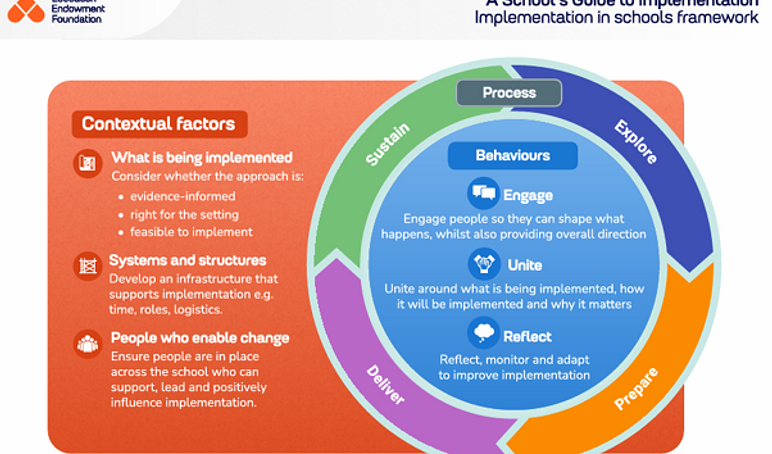
Engaging and Uniting
These are key aspects of implementation from the EEF’s A School’s Guide to Implementation, so from the beginning we engaged our Heads of Department in the strategy (Sharples, Eaton, & Boughlaf, 2024). They attended a meeting equipped with high-level examples of answers to traditionally ‘sticky’ questions – ones that students had struggled to achieve the highest marks on over a sustained period of time. These were predominantly higher-tariff questions.
After input on what Tier 2 vocabulary is, and why it matters, departments analysed the examples they had brought with the specific lens of Tier 2 usage. The findings were striking. Students able to construct precise answers, using accurate academic vocabulary, were highly likely to meet the criteria for the highest levels of the mark schemes.
We were united in understanding that using Tier 2 vocabulary was a lever that could be used to improve academic performance.
Implementation Stages
Alex Quigley’s SEEC (select, explain, explore, consolidate) model provided a staged implementation structure that aligned to our needs in preparing to deliver the strategy (Quigley, 2018).
Stage 1 – Selection
Over an extended period of time, including a curriculum INSET day, Heads of Department and their teams chose the vocabulary that would be of highest utility in their subject area. Initially we stated this should be between five and ten words per year group. This ensured impact without being burdensome. Across a seven-year curriculum, students would learn somewhere between 200 – 300 Tier 2 words.
Some words may be repeated across subject areas, but this is purposeful as they learn the subtle nuance of usage. For example, the word ‘vulnerability’ in geography might be used when discussing natural disasters, whereas ‘vulnerability’ in drama might mean exploring how to construct vulnerability in character portrayal.
Broadly speaking, departments identified two key ways that Tier 2 vocabulary would be of greatest benefit:
1. Conceptual vocabulary (e.g. vulnerability, hubris, conflict)
2. Analytical verbs (e.g. critiques, highlights, infers).
These were choices based on frequency and utility, drawing on evidence from the EEF’s Improving Literacy in Secondary schools (Quigley & Coleman, Improving Literacy in Secondary Schools, 2019).
Stage 2 – Explain
A real strength of our curriculum and teaching approach is the strong culture of retrieval practice. For that reason, we chose Frayer models as our primary tool for vocabulary instruction, acting as graphic organisers to stimulate deep word knowledge.
Departments were given INSET time to construct their Frayer Models so that they had a bank of centralised resources designed to reduce workload, provide consistency, and create alignment in usage.
Stage 3 – Explore
Research shows that repeated exposure to new vocabulary, in multiple contexts is fundamental to deep understanding, retention and application, so we chose approaches that would help deliver this. (Vocabulary in Action: Classroom Strategies for vocabulary and language, 2023)
Learning walks happen every lesson here, so we were confident that questioning and modelling were secure practices that could be adapted to maximise the impact of Frayer models.
In terms of questioning, staff were given exemplar questions as well as being shown model lesson recordings, followed by structured opportunities to create their own questions so they could put this into practice immediately.
Modelling is embedded in our teaching and learning culture. Staff are confident using visualisers, so we used the gradual release model of ‘I do, we do, you do’ allowing teachers to go beyond checking for understanding to checking for accurate and precise use of language at each stage of practice.
Stage 4 – Consolidation
Retrieval is embedded into our teaching blueprint, most notably through the use of 5‑a-day questions at the beginning of every lesson. By including Tier 2 questions in retrieval we can interleave and distribute practice so that the learning is regularly revisited and applied in various contexts.
We will also use summative assessments to consolidate usage. In our recent PPEs we have been able to track the use of Tier 2 vocabulary, with Heads of Department completing further reviews through moderation procedures and subsequent achievement conversations. This allows us to triangulate evidence and draw conclusions about how well this strategy has been achieved.
Next Steps
We will continue to run focused learning walks to monitor the quality and consistency of implementation so that we can make real-time adjustments. Our focus is on meaningful engagement, not superficial adoption, so we will continue to review and refine before building on this work by looking at sentence expansion.
References
Fund, E. E. (2023). Vocabulary in Action: Classroom Strategies for vocabulary and language. Retrieved from Education Endowment Fund: https://educationendowmentfoun…
Quigley, A. (2018). Closing the Vocabulary Gap. Routledge.
Quigley, A., & Coleman, R. (2019). Improving Literacy in Secondary Schools. London: Education Endowment Foundation.
Sharples, P. J., Eaton, J., & Boughlaf, J. (2024). A School’s Guide to Implementation. London: Education Endowment Fund.
23 Mar
in-person
Thorough explore of rec. 1 and 2 from the guidance, how we apply this to our classrooms and bring parents with us.
Gloucestershire Research School at The GLA Trust
03 Mar - 16 Jun
in-person/online
Delving deeper into what disadvantage and living on a low income really means for your pupils.
Gloucestershire Research School at The GLA Trust
This website collects a number of cookies from its users for improving your overall experience of the site.Read more