03 Mar - 16 Jun
in-person/online
Pupil Premium Network Sessions
Delving deeper into what disadvantage and living on a low income really means for your pupils.

Gloucestershire Research School at The GLA Trust
—
Blog
The first step in creating a robust strategy is to understand the nature of the problem
Share on:

by Gloucestershire Research School at The GLA Trust
on the

Alex is assistant headteacher for teaching and learning at Churchdown School Academy, a secondary school in Gloucestershire.
Across the country, too many students struggle to express their ideas in writing despite having brilliant opinions. As a GCSE English language examiner, I have observed time and again that lower attaining pupils don’t lack ideas, they lack precise and accurate written expression to convey their thinking.
It is our responsibility as leaders to react to these observations with curiosity and not assumption. Therefore, the first step in creating a robust strategy was to understand the nature of the problem.
Defining the Problem
There are two key publications that I started with, ‘What is the research evidence on writing?’ (DfE, 2012) and ‘Understanding current practice and research priorities in teaching Writing’ (EEF, 2024). These were written twelve years apart and reveal how little empirical evidence there is for writing pedagogy, especially beyond the primary phase. It becomes difficult to comprehend a problem when our understanding of academic writing instruction and pedagogy is limited.
In the time lapse between these two reports there have also been significant social shifts that negatively impact students’ quality of writing. Platforms such as Snapchat, Instagram and TikTok increasingly immerse students in visual communication, not written. We have seen the impact of this in schools where quality writing and student stamina seem to be in decline.
During this phase of defining the issue I read widely. The Writing Revolution (Hochman & Wexler, 2017), Closing the Writing Gap (Quigley, 2022) and Bringing Words to Life (Beck et al, 2013) became even more well-thumbed and a conversation with Jennifer Webb about the implementation of writing approaches at Carlton Academy Trust refined my thinking and clarified the direction of travel (Webb, 2025).
Responding to the Research Gap
What quickly emerged was that there is a sequence for improving writing with vocabulary as the starting point. Improving Literacy in Secondary Schools (EEF, 2021) emphasises the importance of explicit vocabulary instruction and structured writing approaches. Similarly, Alex Quigley’s research has identified that tier 2 vocabulary knowledge is key to social mobility (Quigley, 2018).
Our moral objective was clear: we wanted our students to become more fluent and articulate in their written communication and if a barrier to this was tier 2 vocabulary, then we needed to act. The Matthew Effect – where the word rich become richer and word poor become poorer – is perhaps more acute with tier 2 vocabulary. We want our students to have equitable access to the knowledge of language that will help them to be successful, both in school and beyond.
As a school, we had already raised awareness of tier 3 vocabulary in earlier professional development reading strategies so there were solid foundations in place for the work on tier 2. Later in the sequence of professional development, we will move to sentence construction and planning but first we need to master the kind of vocabulary that will allow students to write with the clarity, nuance and control that allows them to convey their thinking clearly.
Devising the Vision
As an English specialist there was a distinct danger that the decision to implement a writing strategy could be seen to be irrelevant to individual departments. At worst, people may just see it as ‘literacy again.’ We had to create a compelling rationale that would resonate across different departments.
Our school motto, ‘Churchdown students can,’ was an important platform from which to launch our vision. Our core values provided us with an important moral purpose for introducing this strategy. By embedding the strategy into the School Improvement Plan we ascribed such value to academic writing that it became one of our core objectives.
This then naturally filtered into Middle Leader Improvement Plans. We united all staff to a common goal and this alignment between departmental and whole-school priorities meant that we were sending a clear message that this work was not an optional ‘add on’ but was a driver for academic success.
Launching this strategy needed careful narrative framing. Our mantra became ‘A vocabulary gap is a knowledge gap. A knowledge gap is a curriculum gap.’ By reframing writing as knowledge rather than a skill we a made an important semantic shift. It clarified the idea that written communication is something that we have control over. It is not something a student either can or cannot do. We have the potential to help them to succeed in every subject area.
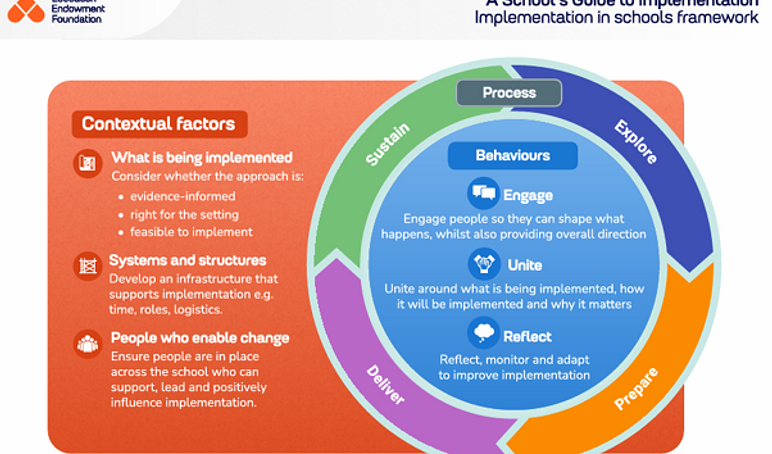
We then ensured that we had the systems to implement the strategy effectively. A CPD calendar, regular planned quality assurance, and built-in reflection points combine to help us to monitor impact and refine practice in this whole-school strategy.
We were ready to begin.
Read part two here
References
Beck, I. L., McKeown, M. G., & Kucan, L. (2013). Bringing Words to Life. New York: The Guildford Press.
Grima, Hooper, Redmond, M., Sharott, & Ashworth. (2024). Understanding current practice and research priorities in teaching Writing. Millbank: EEF. Retrieved from https://educationendowmentfoundation.org.uk/education-evidence/evidence-reviews/writing-practice-review
Hochman, J. C., & Wexler, N. (2017). The Writing Revolution. San Francisco: Jossey-Bass.
Quigley, A. (2018). Closing the Vocabulary Gap. Abingdon: Routledge.
Quigley, A. (2022). Closing the Writing Gap. Abingdon: Routledge.
Quigley, A., & Coleman, R. (2021). Improving Literacy in Secondary Schools: Guidance Report. EEF. Retrieved from https://educationendowmentfoundation.org.uk/education-evidence/guidance-reports/literacy-ks3-ks4
Webb, J Conversation (2025)
Education Standards Research Team (2012). What is the research evidence on writing? London: DfE. Retrieved from https://assets.publishing.service.gov.uk/media/5a7b1474ed915d429748cadf/DFE-RR238.pdf
03 Mar - 16 Jun
in-person/online
Delving deeper into what disadvantage and living on a low income really means for your pupils.
Gloucestershire Research School at The GLA Trust
23 Mar
in-person
Thorough explore of rec. 1 and 2 from the guidance, how we apply this to our classrooms and bring parents with us.
Gloucestershire Research School at The GLA Trust
This website collects a number of cookies from its users for improving your overall experience of the site.Read more