Blog
Cross-phase
Inclusive Line Management Series
Derby Research School
—
Blog
Reflections from a Trust-Wide Implementation Journey
Share on:

by Derby Research School
on the

Trust Executive Primary Vice Principals, Spencer Academies Trust

Trust Executive Primary Vice Principals, Spencer Academies Trust
As a multi-academy trust, we have a long-standing commitment to evidence-informed practice, balanced with professional autonomy. We work alongside schools rather than prescribing a single teaching and learning model, supporting leaders to make evidence-informed decisions that work within their context.
But as our trust grew, we began to recognise a challenge: were we always talking about the same thing when we talked about great teaching and inclusion?
Across education, a growing number of terms were shaping conversations about classroom practice: Quality First Teaching, High-Quality Teaching, Adaptive Teaching, Targeted Academic Support and, increasingly, Inclusive Teaching.
All had value, but the “jingles and jangles” of educational language were becoming a distraction. Similar ideas were described differently, while identical terminology could mask quite different interpretations.
Our challenge was not simply to agree a definition. We needed to create greater coherence around what effective, inclusive classroom practice actually looked like.
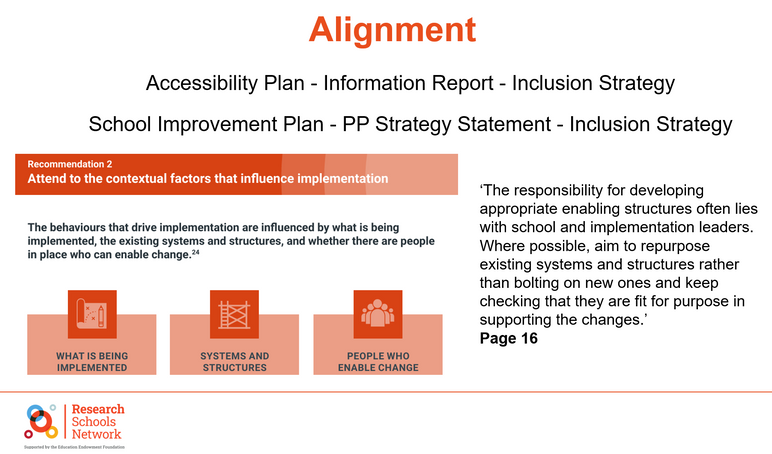
The EEF’s Guide to Implementation reminds us that implementation success depends upon developing shared understanding, consistent practice and aligned beliefs.
Poor implementation often stems from differences in values, understanding and day-to-day practice. Colleagues may appear to agree whilst holding very different interpretations of key ideas.
The guidance highlights that implementation is fundamentally a collaborative and social process, shaped by how people think, behave and interact. Our growing lack of coherence around teaching and inclusion was creating a barrier to collaborative improvement across our trust.

The EEF’s Guide to Implementation helped us think carefully about this problem. Successful implementation requires more than introducing a new resource or framework. It depends upon developing shared understanding, consistent practice and, crucially, aligned beliefs.
We returned to the evidence base, including Tom Sherrington’s Rosenshine’s Principles in Action, and three deceptively simple questions:
What do we want pupils to learn? Curriculum
How will we help them learn it? Pedagogy and adaptive teaching
How will we know they have learned it? Assessment
These became foundations for our developing model of inclusive teaching. We also recognised the importance of behaviour, attitudes and metacognition in establishing the conditions in which pupils can learn.

Uniting around Shared Knowledge and Understanding – developing a conceptual model helped create greater coherence across our trust by providing:
> a shared understanding of the key components of effective teaching
> a common language to describe those components
> greater clarity about the relationship between curriculum, pedagogy, assessment and inclusion
Importantly, it also helped colleagues see how trust-wide priorities connected together.
A conceptual model was only the beginning. If inclusive teaching was going to make a difference, it needed to influence what happened in classrooms.
We identified adaptive teaching as the critical bridge between inclusive ambition and classroom practice.

Our Adaptive Teaching Framework therefore focuses on three things for each principle:
> the key idea
> the implications for teacher practice
> common pitfalls and non-examples.

Importantly, we did not want this to become another standalone initiative. Implementation has worked through existing trust structures, bringing together school improvement leads, Teaching and Learning Leads, SENDCos and Behaviour Leads, supported by practical materials and ongoing opportunities for reflection and refinement.
As is often the case in education, the landscape continued to evolve.
Just as we were launching our model and Adaptive Teaching Framework, the EEF published its Guide to Inclusive Teaching. Our instinct was naturally to hold our work up against the new guidance: what had we got right, and what might we need to rethink?

The answer was reassuring, but also challenging.
The guidance strongly reinforced the relationship between universal approaches, adaptation and additional support. It connected closely with both the EEF’s tiered approach to Pupil Premium and the graduated approach to SEND.
Most importantly, it reinforced a principle at the heart of our work: build the strongest possible foundation for inclusion through what happens in classrooms every day.
It strengthened our conviction that adaptive teaching is central to inclusive practice. As Marc Rowland has argued, “every interaction is an intervention.” Getting everyday teaching right remains one of our most powerful levers for improving outcomes.
Perhaps the most useful aspect of the EEF guidance, however, was that it made us pause.
Much of our work had understandably concentrated on shared language, frameworks and classroom practice. But had we paid enough attention to the beliefs and assumptions sitting underneath them?
The myths highlighted within the guidance, including the idea that inclusion is primarily about doing something different for pupils with additional needs, raised an important implementation question for us.
Do we sometimes spend too much time training people in what to do, without spending enough time developing a shared understanding of why?
That feels like the next stage of our journey.
The EEF’s Guide to Inclusive Teaching has provided validation, challenge and useful food for thought.
Our experience has reinforced that successful implementation is not simply about introducing a new framework. It requires coherence between what we know, what we do and what we believe.
Our work continues, but we are clearer than ever that inclusive teaching should not become another initiative or educational label.
It is simply how we ensure every pupil can access, participate in and succeed through learning.
Sherrington, T. (2019). Rosenshine's Principles in Action. John Catt Educational
Rosenshine, B. (2012) 'Principles of Instruction: Research-Based Strategies That All Teachers Should Know', American Educator, 36(1), pp. 12-19, 39.
This website collects a number of cookies from its users for improving your overall experience of the site.Read more