Blog
literacy
•Primary
•implemetation
Phonics is the key to unlocking reading. Reading is the key to unlocking learning
ELE, English Hub lead and Primary Head of School Beth Dawson talks phonics
Sarah McGee
Carmel Research School is no longer active. We are continuing to support schools in the region through the wider Research School Network.
Search for other Research Schools in your area—
Why would we want learners to fail? Surely teaching is all about helping learners to be successful? by David Bailey

Share on:

by Carmel Research School
on the
This blog aims to outline the importance of (controlled) failure, how metacognition helps and how, together, these can bring greater success.
Problem solving at school
How do I know how to estimate the answer to 42 x 28?
The answer begins with a failure that I experienced in a maths class some years ago (when I was in what is now called year 8) and my first conscious awareness of metacognitive processes. There are two other characters in this story that were instrumental in this: I was fortunate to have a rather brilliant maths teacher (Mr Baxter), who created the opportunity and one of my classmates (Michael) was the one who supplied the key information.
The teacher had set the class up with a challenge. He asked us to try to solve a problem that we hadn’t tried to solve before, and this was something that we hadn’t been taught. We were asked to estimate the answer to a mathematical problem in which we multiplied together a pair of two digit numbers.
I forget the exact numbers that were used, but I remember the rest of the conversation as if it had taken place yesterday.
We were given the two numbers (say 42 x 28) and had to write down the approximate answer, then put our papers aside. I had struggled to answer the question in the time (we weren’t given too long in case we had attempted long multiplication).
The teacher asked for and answer. Michael was the only person in the class to put his hand up. The teacher, unswayed by Michael’s hand being in the air, asked a couple of others in the class who either provided no answer or an incorrect answer. Michael was then asked to give his answer, to which he replied “it would be about 1200”.
The teacher probed further, saying “An interesting answer Michael, how did you work it out?”
Michael then articulated that he had rounded one number up (to 40) and the other number down (to 30) and then multiplied these answers together.
The teacher then pulled out his calculator and handed this to another child and asked them to work it out, to which they replied “1176”.
“Hmmm, pretty close, I’d say” said the teacher. He then went on to ask “Which was faster, Michael’s answer or the one with the calculator?”
After a couple of other problems, the class agreed that the method that Michael had described was quicker and would do nicely if an approximate answer was needed.
The teacher then gave a series of similar problems and asked others to work them out, repeating the same two questions:
What is the answer?
How did you work it out?
Before long, many children in the class had provided an answer to a question similar to the first.
Many years on, I can still remember how it was done, so it is clearly something that was retained in my long-term memory.
Reflecting back on this (and although I didn’t have the language to describe this fully at the time), there are two key components to this:
The opportunity for failure (what you might describe as a challenging task)
A metacognitive process to highlight the steps in failure and success
Fear of Failure
Imagine the interview for a teaching post. The candidate is asked how they help pupils make good progress. The response ‘by making sure that they fail regularly’ would raise some eyebrows to say the least. Parents and teachers want the best for their children and thinking about failure seems quite removed from this.
With the work that I have carried out with a number of schools, I have encountered this ‘Fear of Failure’ on many occasions. Interestingly, it seems more common in schools with lower Ofsted categories (which although understandable is not necessarily helpful).
Also, the fear for failure seems to go further than with pupils alone, which is perhaps something to explore another time…
Thinking back to the response from the teacher a the start of this blog, the ‘by making sure that they fail regularly’ would only be part of the story. Making sure they failed regularly and helping them to understand how to do succeed next time, would be something important to add. This is something that as teachers we understand as a process of learning.
A note on language – the notion of failing regularly is not the same as failing frequently. Failing frequently is something that is likely to be demotivating.
The right kind of failure
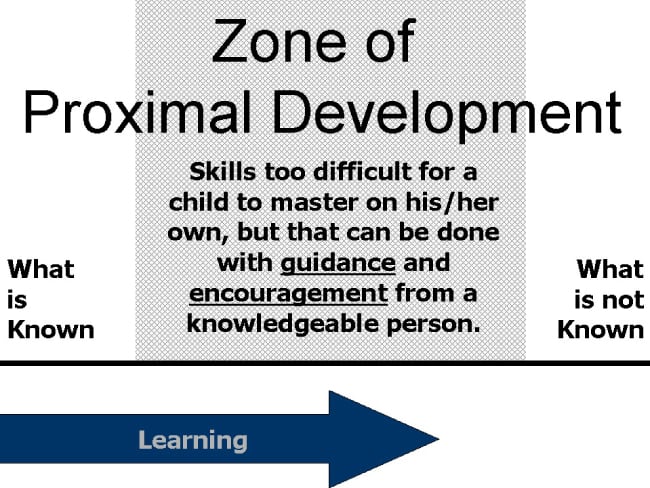
It is also important that the type of failure that is involved is something that the child may be almost capable of (but not quite) and so that after some help, there is a reasonable chance of success. This is something that I became aware of early in my teaching career, as described by the psychologist Lev Vygotsky as the Zone of Proximal Development (ZPD) (more can be found here). As a rule of thumb, if a task is just outside the current capability of a child to complete independently, it would be the right kind of challenge for this type of failure.
With practice, teachers can become adept at finding the ZPD of a child and can use this to good effect to construct the right kind of opportunity to fail forwards.
Being too helpful…
Classroom practitioners (teachers and teaching assistants), are often by their nature helpful people. Thinking back to the interview scenario, we don’t want children to fail over time and as a result sometimes we fall into the trap of making sure that failure doesn’t happen at all, not even in the short-term.
There have been many reports of people who became famous for early failures in their lives or careers, from J.K. Rowling to Walt Disney. These often come as a surprise to some, although personally, I can see how these failures may have contributed to later successes, I can also see how making the connection between failure can be quite a challenge as it may seem counter-intuitive.
The concept of being too helpful is sometimes illustrated by the Parable of the Butterfly, in which a butterfly is helped out of its chrysalis, which has disastrous consequences for the butterfly in question in terms of its ability to thrive.
In terms of how this works in the classroom, the Education Endowment Foundation (EEF) suggested in their guidance report about the use of Teaching Assistants (and to avoid any ambiguity, this guidance also applies to teachers and other helpers, including peers). It suggests that Teaching Assistants should aim to give pupils the least amount of help first. They should allow sufficient wait time, so pupils can respond to a question or attempt the stage of a task independently. TAs should intervene appropriately when pupils demonstrate they are unable to proceed. https://educationendowmentfoundation.org.uk/tools/guidance-reports/making-best-use-of-teaching-assistants/
Deciding on what is the right amount of help can be slightly more challenging and gradually introducing the help through questions firsts and then prompts is an important consideration. It is a process of ‘test and learn’ that gets easier with experience.
What does the research say?
There have been numerous studies into learning from successes and failures and I’d like to focus on just one of these, which is relatively recent. It is referred to in an interview with Ayelet Fishbach, an expert on motivation and decision making at the University of Chicago’s Booth School.
Interestingly the article points out that people learn more from success than failure (which may or may not be surprising to you) and you may be sceptical about the study (being a psychology study on US adults) and whether it is applicable to younger children. However, there is something said in the article which is particularly interesting – “Although people learned less from personal failure than from personal success, they learned just as much from others’ failures as from others’ successes“. In other words, when failure is removed from the self, people tune in and learn from failure.” This part aligns with other research, including that around feedback, for example, Butler (1987) and Kluger and Denisi (1996).
It is this part I’d like to focus on – separating out the sense of self from the failure. This allows us to learn from not just successes but from failures too, both personal and those around us – ‘Objectively-framed failure’.
What do we mean by ‘Objectively-framed failure’?
To summarise the key points from the research above, learning from failure can be challenge. Interesting, the research suggest that praise can be equally challenging. The reason being that we tend to associate our own personal successes or failures with our own ‘self’. According to Carl Rogers, who theorised around the idea of ‘self’ (a helpful summary can be found here) the further we are from our ‘ideal self’ the more our ‘self-worth’ is affected (negatively). Therefore, people tend not to cope well with not succeeding.
The problem is that not succeeding is part of life and particularly part of an educational system that almost universally has the concept of some children doing better than others (in other words ‘successes’ and ‘failures’. Failure is also something that comes with the concept of challenge. Rather than avoid the whole idea of failure (which is almost impossible), the concept of ‘Objectively-framed failure’ aims to refocus how the failure is attributed.
For example, imagine a child who can’t recall the four times tables. Framing this in a way that is associated with the self would mean that the child thinks they are “no good at times tables”, which has a bearing upon the effort that they then put into doing this. Framing this objectively, the child would be refocused on the strategy they used (for example, how did you try and learn this? what was the approach? did the approach you took work well or not? why don’t we try a different approach….)
Be cautious about praise..
Interestingly, the same research points to the value of “objectively-framed success”, that praise, particularly that focused upon the sense of self as it is likely to reinforce the association between the performance on tasks and the sense of self. In the example above, framing the child’s previous success at the two-times table as them being good at times tables/maths, means that they are likely to think that success matters (and they are only good at something if they can do it easily).
In short, it is objectivity (in both success and failure) that helps learning and if treated objectively, helping you to learn from both success and failures.
Metacognition
In case you aren’t familiar with metacognition, it refers to awareness of the process of thinking (or thinking about thinking as it is often described). The Education Endowment Foundation has produced extensive guidance on this (and self-regulation that accompanies this) which can be found here – https://educationendowmentfoundation.org.uk/evidence-summaries/teaching-learning-toolkit/meta-cognition-and-self-regulation/. It is also mentioned in several of the EEF Guidance Reports.
In summary, metacognitive processes include:
- awareness of the process of learning
- thinking out loud (teachers and pupils)
- asking questions of clarification
An evidence review for metacognition and self-regulation can be found here.
Coupled with the right kind of failure and the objective treatment of successes and failure (as outlined above), metacognition helps give us the tools to resolve the failure and to succeed next time.
Resilience and Independence
I have encountered lots of attempts by schools to develop resilience within pupils and many varied approaches have been tried. The approaches suggested here can, used correctly, develop resilience – It’s not how many times you get knocked down, its how you pick yourself back up again and one way to learn how to pick yourself back up again is to do so repeatedly, and then recognise that you have done so.
Children who can pick themselves back up again have gained a certain level of independence from the support of the teacher, which tends to increase over time.
How can we use this as a classroom strategy?
Clear success criteria allows for objective judgements, make sure that pupils and teachers have a shared understanding of these
Separate the sense of ‘self’ from the feedback – it was good or bad because it did or didn’t meet the criteria, not because it was good or bad compared to how the learner normally performs (or others in the class)
Be very cautious about the use of praise and affirmation as part of the feedback process, it can be as ‘harmful’ as criticism
Use metacognitive approaches, questioning and dissection of responses to help improve against the success criteria
Attribute failure and success to successful strategies and/or lack of effort rather that because learners are bad or good at something
Encourage another attempt and when there are successes, look back at how the strategy helped achieve that success and celebrate the resilience they showed
References
Butler, R. (1987). Task-involving and ego-involving properties of evaluation: Effects of differentfeedback conditions on motivational perceptions, interest, and performance. Journal ofEducational Psychology, 79(4), 474 – 482.
Kluger, A. N., & DeNisi, A. (1996). The effects of feedback interventions on performance: Ahistorical review, a meta-analysis, and a preliminary feedback intervention theory.Psychological Bulletin, 119(2), 254 – 284.
Rogers, C. (1959). A theory of therapy, personality and interpersonal relationships as developed in the client-centered framework. In (ed.) S. Koch, Psychology: A study of a science. Vol. 3: Formulations of the person and the social context. New York: McGraw Hill.
This website collects a number of cookies from its users for improving your overall experience of the site.Read more