Blog
Primary
Out of the Cupboard and Into Children's Hands: The Case for Manipulatives in Key Stage 2
Understanding the purpose of manipulatives
Rachel Swann
—
Blog
Identifying the missing brick

Share on:

by Aspirer Research School
on the

ELE
Wider Curriculum Leader, Computing Leader at Sacred Heart R.C. Primary in Gorton Manchester.
Follow Georgina on @GeorgieHoops17
It’s Boxing Day and I am elbow-deep in different Lego projects that my 6‑year-old has received over the festive period. I think about how his logical mind has gone from needing a great deal of support to follow instructions to being a competent and creative Lego builder. Similarly, my mixed Year 5/6 class adores being creative with Lego – I observe how carefree they are in crafting from these safe bricks: they trial, adapt and build their creations competently. It is this skill that our young writers need to adopt in Key Stage 2 when they are asked to write a longer, coherent and creative piece of writing. The task for us as teachers is to identify which part of their writing still needs the explicit instruction that we would have offered to novice writers.
As I spoke about in my previous blog,‘I’m Sorry but Stop Apologising for SEND’, each SEND learner has their own unique barriers and experiences. Therefore, an approach that works for one learner may not be appropriate for another learner with the same difficulty. As educators, we have to identify the missing brick in their writing and support them to fill the gap.
What the research says about SEND

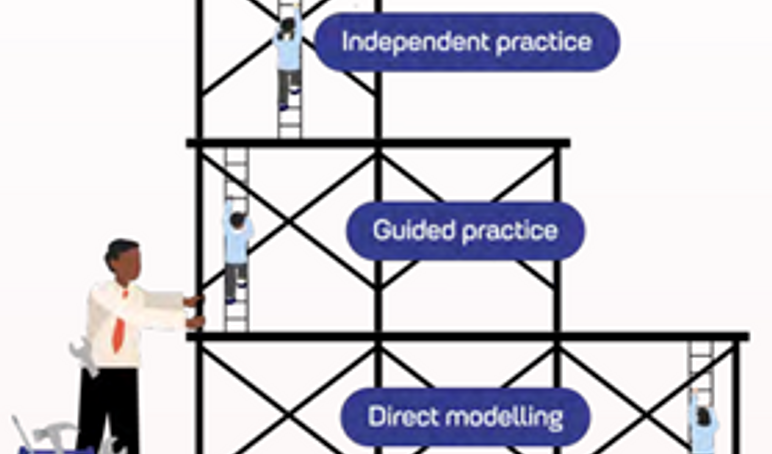
The introduction of the EEF’s guidance report, Special Educational Needs in Mainstream Schools, highlights that our SEND learners“have the greatest need for excellent teaching” and that we should find better ways to close the gap between SEND and our other mainstream learners. This moves away from having a small group taught separately from the main class. Our SEND learners have been taught the same lessons, content and skills as the other children in the class and are still struggling to craft their writing in a Key Stage 2 lesson. Simply teaching it again, more slowly or in a smaller group may not address the missing understanding. As every SEND learner is different, and their needs unique, the approaches should be integrated into everyday, high-quality classroom teaching and so“being inclusive by design not as an afterthought”. Once the need has been identified, applying the 7 step model from the EEF’s guidance report Metacognition and Self-Regulation will allow those children to master the particular strategy through guided practice, and finally use the strategy independently. A teacher who uses these techniques will be able to meet the needs of the SEND children in the classroom.
Where to start when it comes to writing?
Recommendation 2 of the EEF’s guidance report, Special Educational Needs in Mainstream Schools, states the requirement to‘build an ongoing, holistic understanding of your pupils and their needs’. This can seem more daunting as the children move to Key Stage 2. As the quantity of the subject matter increases, there will be more potential“missing pieces” to identify. OFSTED’s (2004) report Strong Foundations in the First Years of School states:“Schools introduce complex reading and writing tasks too early.” Many children that we are teaching in Key Stage 2 are still in need of those explicit instructions that we would give to younger children. Essentially, they are being moved on before the foundations have been established.
The Simple View of Writing

The EEF’s guidance report, Improving Literacy in Key Stage 2,highlights the above model from Beringer et al. (2002) which shows the different elements that a competent Key Stage 2 writer needs. This can serve as a starting point to identify which building block is missing and then assign the appropriate support to target the specific need.
Looking ahead:
In the second blog, I will explore how this same“missing brick” approach has worked with specific children with SEND needs in a working classroom. Through the experiences of four learners, I will outline practical adaptations and targeted interventions that support pupils in developing confidence, structure and independence in their writing allowing them to thrive in a mainstream classroom.
References
The ADHD centre (2023)‘Our top tips & strategies to help students with ADHD’, The ADHD Centre, 21 July.
Available at: https://www.adhdcentre.co.uk/our-top-tips-strategies-to-help-students-with-adhd/(Accessed: 20February 2026)
Bilton, C and Duff, D. (2021) Improving Literacy in Key Stage 2. 2nd edn.
Available at: https://d2tic4wvo1iusb.cloudfront.net/production/eef-guidance-reports/literacy-ks2/EEF-Improving-literacy-in-key-stage-2-report-Second-edition.pdf (Accessed: 20 February 2026)
Education Endowment Fund (2025) Special educational needs in mainstream schools.
Available at: https://d2tic4wvo1iusb.cloudfront.net/production/eef-guidance-reports/send/eef_special_educational_needs_in_mainstream_schools_guidance_report_2025-04 – 10 – 110432_klxp.pdf. (Accessed 20 February 2026)Education Endowment Fund (2025) Metacognition and Self Refulation
Available at: https://educationendowmentfoundation.org.uk/education-evidence/guidance-reports/metacognition(Accessed 20 February 2026)
Morrison, G. (2024)‘I’m sorry but stop apologising for SEND!: Empowering SEND students as a teacher with Single Sided Deafness (SSD)’, Aspirer Research School, 27 November.
Available at: https://researchschool.org.uk/aspirer/news/im-sorry-but-stop-apologising-for-send. (Accessed 20 February 2026)
OFSTED (2024) Strong foundations in the first years of school. 8 October.
Available at: https://www.gov.uk/government/publications/strong-foundations-in-the-first-years-of-school/strong-foundations-in-the-first-years-of-school. (Accessed: 20 February 2026)
Department for Education (2026). Curriculum and Assessment Review: Building a world class curriculum for all. 26 November.
Available at: https://www.gov.uk/government/publications/curriculum-and-assessment-review-final-report. (Accessed 21 February 2026)
This website collects a number of cookies from its users for improving your overall experience of the site.Read more